

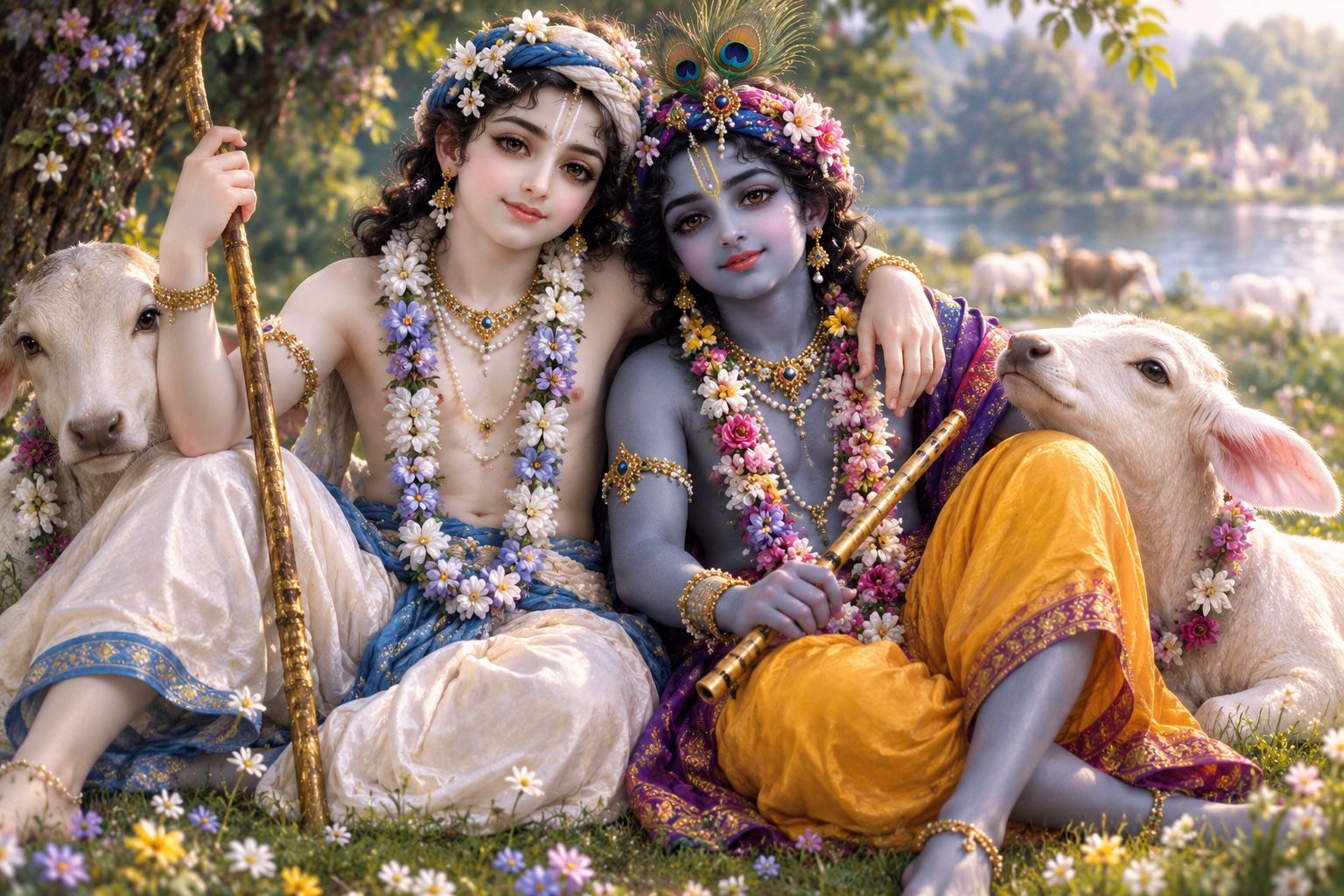
Balarāma Pūrṇimā is the sacred appearance day of Śrī Balarāma, the first expansion of Śrī Kṛṣṇa and the original spiritual master. Yet the story of His appearance contains a beautiful mystery that is not commonly understood.
We generally hear that Balarāma first appeared in the womb of Devakī and was then transferred by Yogamāyā into the womb of Rohiṇī. This is certainly described in Śrīmad-Bhāgavatam, but the deeper explanation given by the Gauḍīya ācāryas reveals something even more wonderful.
Balarāma Was Already in Rohiṇī’s Womb
When Vasudeva sent Rohiṇī to Vraja for her protection from Kaṁsa, she was already pregnant. The explanations of the ācāryas, including Śrī Jīva Gosvāmī, describe Rohiṇī as being approximately three months pregnant when she arrived in Vraja. The Vrajavāsīs therefore knew that Rohiṇī was expecting a child.
One may naturally wonder: How could Rohiṇī have become pregnant while Vasudeva was in prison? The “prison” was not an impenetrable confinement in the modern sense; it was essentially a guarded house arrest, and close relatives could still visit Vasudeva and Devakī. Rohiṇī, being Vasudeva’s wife, was able to come to them, and it was during this period that she became pregnant. Vasudeva then sent her secretly to Vraja for her safety.
Then came the extraordinary event described in Śrīmad Bhāgavata. Devakī was carrying her seventh child, and through the potency of Yogamāyā, that child was transferred from Devakī’s womb to Rohiṇī’s womb. Everyone believed that Devakī had suffered a miscarriage.
But here lies the mystery.
According to the deeper Gauḍīya explanation, the original Balarāma was already present in Rohiṇī’s womb. The child transferred from Devakī was an expansion of Balarāma—Saṅkarṣaṇa-tattva—which then merged into the original Balarāma in Rohiṇī’s womb. Thus, Balarāma did not simply travel from one womb to another. Rather, His expansion was transferred to Vraja and merged into His original form there.
This also explains the extraordinary length of Rohiṇī’s pregnancy described in the Gauḍīya tradition: Balarāma remained in Rohiṇī’s womb for approximately fourteen to sixteen months before His appearance.
And then, on Śrāvaṇa Pūrṇimā, Balarāma appeared from the womb of Rohiṇī—seven days before Śrī Kṛṣṇa’s appearance on Janmāṣṭamī.
This also helps explain the distinction from the well-known Balarāma Ṣaṣṭhī observance, which is celebrated in some traditions after Janmāṣṭamī and is sometimes regarded as Balarāma’s appearance day. If Balarāma’s appearance were placed there, the chronology would leave roughly a year between His appearance and Kṛṣṇa’s, which does not harmonize with the way They were raised and celebrated together in Vraja. The Śrāvaṇa Pūrṇimā understanding is therefore the chronological conclusion followed in the Gauḍīya tradition on the basis of Jīva Gosvāmī’s reasoning.
Jīva Gosvāmī’s chronological reasoning is especially significant here. Balarāma and Kṛṣṇa were treated as almost the same age in Vraja: their naming ceremony, other childhood ceremonies, and development were performed together or nearly together, and they were raised and treated in essentially the same way. There is no indication of a gap of many months between them. The Gauḍīya explanation therefore understands Balarāma’s appearance on Pūrṇimā immediately preceding Kṛṣṇa’s Janmāṣṭamī, rather than placing His birth an entire year earlier. This beautifully harmonizes the chronology of Their Vraja-līlā.
Their loving relationship was equally extraordinary. They would sit together on the same seat and eat from the same large plate, sometimes playfully quarreling over who would feed the other first. When Balarāma fed Kṛṣṇa, He felt great joy seeing how nicely Kṛṣṇa ate and chewed; and when Kṛṣṇa fed Balarāma, He felt satisfied as though His own hunger were being relieved. Their love was so deep that each felt inwardly nourished by the happiness of the other. In this way, They were raised together with the greatest affection, sharing everything as loving brothers.
The Same Mystery Appears in Kṛṣṇa’s Birth
The mystery does not end with Balarāma.
Most devotees are familiar with the beautiful story of Kṛṣṇa appearing in the prison of Kaṁsa in Mathurā. Vasudeva sees the four-armed Lord, who then manifests His childhood form, and Vasudeva carries Him across the Yamunā to Gokula.
That is true—but it is not the complete inner mystery.
The Gauḍīya ācāryas explain that at the very same time, the original Śrī Kṛṣṇa, Vrajendra-nandana and Yaśodā-nandana, appeared in Vraja from the womb of Mother Yaśodā. The Kṛṣṇa who appeared in Mathurā was Vāsudeva-Kṛṣṇa, an expansion of the original Vraja-Kṛṣṇa. When Vasudeva brought Him to Gokula, Vāsudeva-Kṛṣṇa merged into the original Kṛṣṇa who had appeared from Yaśodā. Jīva Gosvāmī elaborates on this profound mystery in Gopāla-campū.
And there is an even more beautiful detail in this mystery: Yaśodā Maiyā did not give birth only to a daughter. She gave birth to Kṛṣṇa as well. At the same time that Kṛṣṇa appeared in Devakī’s womb in Mathurā, the original Vrajendra-nandana Kṛṣṇa appeared from Yaśodā’s womb in Vraja. Shortly afterward, Yaśodā also gave birth to a daughter—Yogamāyā—so the two appeared as twins. When Vasudeva arrived in Gokula carrying Vāsudeva-Kṛṣṇa, the potency of Yogamāyā prevented him from seeing the original Kṛṣṇa lying there. He therefore placed Vāsudeva-Kṛṣṇa beside Yaśodā’s children and took the baby girl, Yogamāyā, back to Mathurā. At that moment, Vāsudeva-Kṛṣṇa merged into the original Yaśodā-nandana Kṛṣṇa.
This is why the Vraja conception of Kṛṣṇa is so intimate: He is not merely a child who came from Mathurā and was brought to Vraja. He is eternally the son of Nanda and Yaśodā, the original Kṛṣṇa of Vraja.
The Gopīs themselves—the greatest authorities on Kṛṣṇa’s Vraja-līlā—declare this in the very first verse of the Gopī-gīta:
जयति तेऽधिकं जन्मना व्रजः
श्रयत इन्दिरा शश्वदत्र हि ।
दयित दृश्यतां दिक्षु तावकाः
त्वयि धृतासवस्त्वां विचिन्वते ॥
jayati te’dhikaṁ janmanā vrajaḥ
śrayata indirā śaśvad atra hi
dayita dṛśyatāṁ dikṣu tāvakās
tvayi dhṛtāsavas tvāṁ vicinvate
“Your birth here in Vraja has made it exceedingly glorious. Goddess Lakṣmī eternally resides here. O beloved, please appear before us; we are searching for You in every direction, having dedicated our very lives to You.”
“Your birth in Vraja has made Vraja glorious.” The Gopīs themselves are therefore proclaiming Kṛṣṇa’s birth in Vraja.
There is another remarkable indication in Śrīmad-Bhāgavatam. Immediately after Kṛṣṇa’s appearance, Śukadeva Gosvāmī says:
नन्दस्त्वात्मज उत्पन्ने जाताह्लादो महामनाः ।
आहूय विप्रान् वेदज्ञान् स्नातः शुचिरलङ्कृतः ॥
वाचयित्वा स्वस्त्ययनं जातकर्मात्मजस्य वै ।
कारयामास विधिवत् पितृदेवार्चनं तथा ॥
nandas tv ātmaja utpanne jātāhlādo mahā-manāḥ
āhūya viprān veda-jñān snātaḥ śucir alaṅkṛtaḥ
vācayitvā svastyayanaṁ jāta-karmātmajasya vai
kārayām āsa vidhivat pitṛ-devārcanaṁ tathā
(Śrīmad-Bhāgavatam 10.5.1–2)
“When his son was born, Nanda Mahārāja became filled with great joy. He invited learned brāhmaṇas and, according to Vedic regulations, had the jāta-karma birth ceremony performed for his son.”
The significance is striking: Nanda Mahārāja performs the jāta-karma ceremony for his own son. The Gauḍīya ācāryas draw attention to this verse as one of the Bhāgavata’s indications of the deeper mystery of Kṛṣṇa’s Vraja appearance. Jīva Gosvāmī himself cites SB 10.5.1 in this connection in Laghu-bhāgavatāmṛta.
And Brahmā himself addresses Kṛṣṇa as:
…मृदुपदे पशुपाङ्गजाय ॥
…mṛdu-pade paśupāṅgajāya
—“unto You, the son of the cowherd,” in his prayers to Kṛṣṇa in Śrīmad-Bhāgavatam 10.14.1.
Thus, the Bhāgavata repeatedly gives us these beautiful indications of Kṛṣṇa as the son of Nanda and the Lord of Vraja.
Why Does This Matter?
These mysteries are not merely fascinating details about Kṛṣṇa and Balarāma’s births. They reveal the unique position of Vraja.
The original Kṛṣṇa never leaves Vṛndāvana, and Balarāma, His eternal elder brother and first expansion, is eternally with Him. Their manifestations outside Vraja are expansions of Their original Vraja forms.
And this reveals something beautiful about Balarāma Himself.
Balarāma is the original servant of Kṛṣṇa. He serves Him in every possible way—in śānta-rasa as His paraphernalia and abode, in dāsya-rasa as His servant, in sakhya-rasa as His intimate friend and elder brother, and in vātsalya-rasa as His protector and guardian. And in mādhurya-rasa, He serves Kṛṣṇa in His feminine form as Śrī Ananga Mañjarī, the younger sister of Śrīmatī Rādhārāṇī.
This is the glory of Balarāma: His entire existence is service to Kṛṣṇa.
For the sādhaka, this is perhaps the greatest lesson of Balarāma-tattva.
The word bala means strength. But the strength Balarāma gives is not merely bodily strength—it is spiritual strength, the strength to perform bhajana, to take shelter of the holy name and to continue on the path of devotion.
And in Kali-yuga, that same Balarāma appears as Śrī Nityānanda Prabhu, freely distributing the mercy of divine love.
As Śrīla Narottama dāsa Ṭhākura sings:
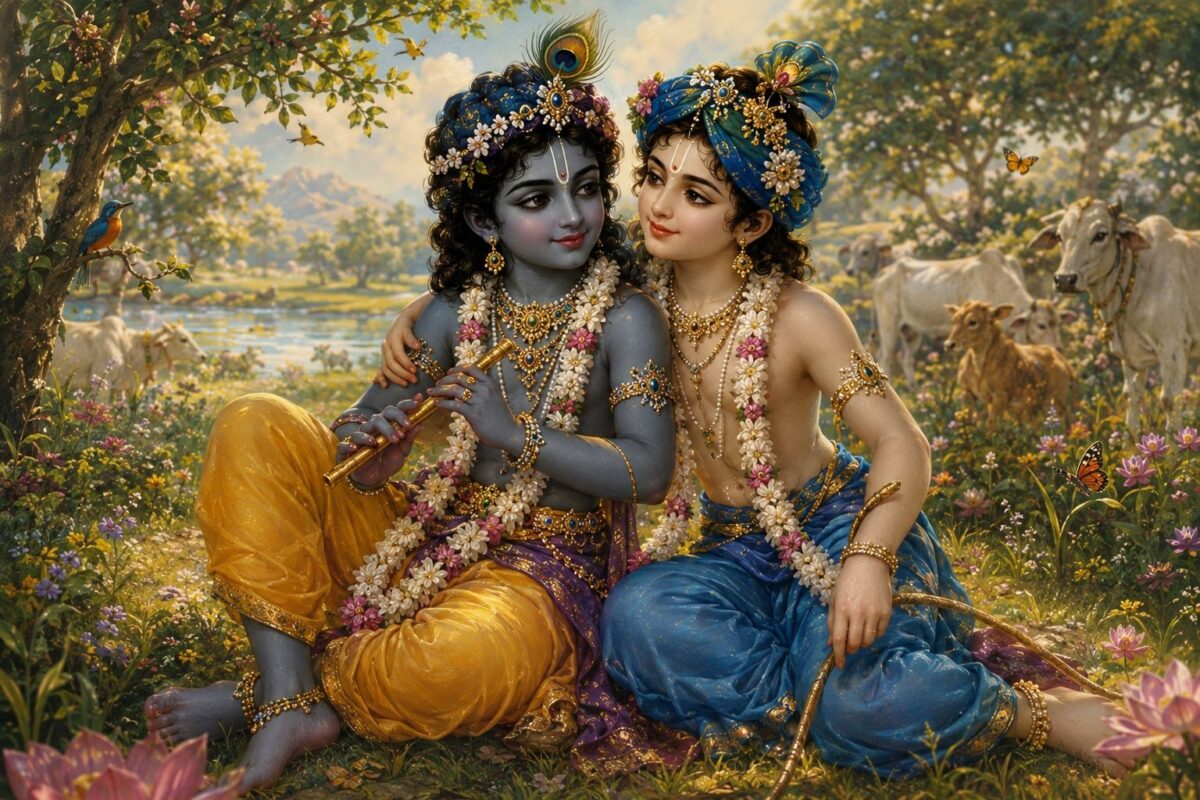
ব্রজেন্দ্র-নন্দন যেই, শচী-সুত হইল সেই,
বলরাম হইল নিতাই।
vrajendra-nandana jei, śacī-suta hoilo sei,
balarāma hoilo nitāi.
“He who was formerly Vrajendra-nandana became the son of Śacī, and Balarāma became Nitāi.”
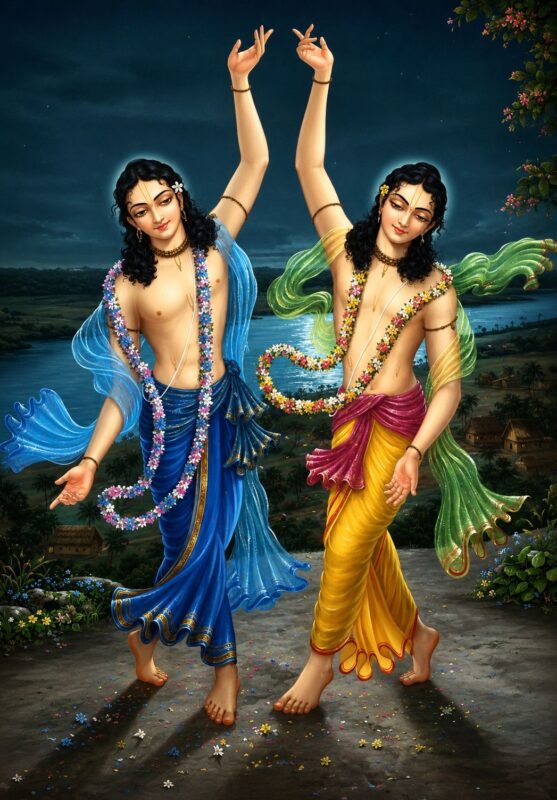
Thus, in the mercy of Nityānanda Prabhu, the compassion of Balarāma has descended into this age. The same Balarāma who serves Kṛṣṇa in every rasa now comes as Nitāi to give the fallen souls of Kali-yuga the strength to take shelter of the holy name and attain divine love.
So on this auspicious Balarāma Pūrṇimā, we do not simply remember the appearance of a great personality. We pray for the mercy and strength to serve Śrī Kṛṣṇa.
This article is only a small offering and a humble attempt from our side. Whatever has been presented here is possible only by the mercy of Gurudeva. If there are any mistakes, shortcomings, or faults in this offering, please kindly forgive us. We humbly request everyone to overlook whatever may be imperfect and accept whatever is beneficial, just as the swan, or haṁsa, is said to separate milk from water—accepting the milk and leaving aside the water. In the same way, may you kindly accept whatever good or useful you find here and forgive or disregard any mistakes.
May Śrī Balarāma, the original servant of Śrī Kṛṣṇa and the reservoir of spiritual strength and mercy, keep us always at His lotus feet and engage us in the service of Śrī Śrī Rādhā-Kṛṣṇa.
Śrī Balarāma Pūrṇimā ki jaya!
Śrī Rādhā-Kṛṣṇa ki jaya!
Jai Nitāi!