

One time, during the rāsa dance, Śrīmatī Rādhārāṇī was dancing while Kṛṣṇa played His flute. Her anklebells were jingling along with the rhythm:
tathathai thai tathathai thai tathathai tā…
when, by accident, one of Her anklebells slipped off Her foot.
Now the rhythm was a little uneven. But what could She do? If She stopped to fix it, the flow of the līlā would be broken.
Śyāmasundara noticed the problem immediately. He handed His flute to Viśākhā-sakhī, who picked up the same melody and continued playing while joining Rādhikā in the dance. Following Her movements, He quickly found the missing nūpura and fastened it back onto Her ankle without Her missing a single step.
They continued dancing together in perfect harmony.
There is a similar līlā involving Tulasī/Rati Mañjarī.
Once, when Rādhārāṇī was dancing in front of the sakhīs, She suddenly realized that She had left Her upper cloth back in the Nikuñja kuṭīra where She and Kṛṣṇa had enjoyed Their intimate pastimes. None of the sakhīs had noticed yet, but when they did, surely they would laugh at Her.
With a glance, She indicated the problem to Tulasī.
Tulasī understood immediately. She ran back to the Nikuñja kuṭīra, brought the cloth, and returned to dance alongside Her Svāminī. Without interrupting the dance or attracting anyone’s attention, she smoothly put the cloth back on Rādhikā. No one watching had any idea what had happened.
Kṛṣṇa was very happy to have the opportunity to serve His beloved in a similar way. However, He did not quite stick the landing like Tulasī.
When the dance was over, Śrīmatī noticed that He had put the anklebell on upside-down!
Kṛṣṇa always wishes to serve Śrīmatī Rādhārāṇī just as Her mañjarīs do. He knows that, among everyone in Vṛndāvana, they possess the highest mood, the purest love for His Śrīmatī, and the deepest relish of the sweetness of Their līlās.
Sometimes He tries to serve Her like them.
But He is not really fully capable of it.
Kṛṣṇa Tries to Serve Like the Mañjarīs
Kṛṣṇa in the comparison of Mañjarīs has very little knowledge of the arts of women—their hairstyles, clothing, ornaments, and all the countless details of their adornment.
Of course, Kṛṣṇa greatly enjoys seeing His Rādhikā beautifully dressed and decorated for Their meeting. Indeed, this is the very fulfillment of Her beauty:
sā kṛṣṇa-netra-kutukocita-rūpa-veśaṃ
varṣmāvalokya mukure pratibimbitaṃ svam
kṛṣṇopasatti-taralāsa varāṅganānāṃ
kāntāvalokana-phalo hi viśeṣa-veśaḥ(Govinda-līlāmṛta 2.105)
Seeing Her own beautiful form reflected in the mirror, dressed in garments and ornaments perfectly suited to delight Kṛṣṇa’s eyes, Rādhārāṇī became restless with longing to meet Him. For what is the true fruit of a beloved woman’s exquisite adornment? It is fulfilled only when her lover beholds her beauty.
But when She is standing before Him, more radiant than the sun, with Her shyly downcast eyes, certainly His attention is not on the way Her sari has been folded!
Śyāmasundara’s expertise is much more in destroying Her decorations than in arranging them.
His other difficulty is that He lacks the composure of the mañjarīs.
More importantly, their mood is completely unique, and Kṛṣṇa cannot imitate it.
The mañjarīs are buds on the golden creeper of Śrīmatī Rādhārāṇī. They are nondifferent from Her, and they experience everything She experiences. In fact, they experience it a hundred times more intensely.
Her happiness when She meets Śyāma—they feel it.
Her pain in separation from Him—they feel it a hundredfold.
And yet, they continue their sevā.
How could they not?
When Yugala Kiśora are enjoying Their intimate pastimes, there is so much to be done. Sometimes They will need refreshments, cool drinks, or sweets to nibble on. Sometimes They will begin to perspire and need air from a fan or cāmara, or the mañjarīs may need to gently wipe the perspiration from Their bodies with a cloth. Sometimes the mañjarīs will sing a romantic song or play a particular rāga to create the proper mood.
All of this must be done with the greatest care and attention, at precisely the right moment and in exactly the way They desire.
It is not a matter of performing the same routine tasks from a checklist. Every moment is different.
The mañjarīs must be completely absorbed in the mood of Yugala Kiśora so that they can understand exactly what They need at that particular moment.
They are silent and practically invisible, anticipating their Svāminī’s wishes even before She herself realizes them, so that nothing disturbs the flow of the līlā.
And when Śrīmatī Rādhārāṇī is burning in the fire of separation, now more than ever She needs the sevā of Her mañjarīs.
They may remind Her of Her sweet pastimes with Śyāmasundara. They may offer some amusement to distract Her mind. They may prepare a bed of cooling lotus petals to soothe the heat in Her soft body.
At this time, the mañjarīs are also burning in separation.
But it does not matter.
Their sevā must continue.
Their love for Rādhikā is so deep that whatever they themselves are experiencing, they put it aside in order to care for Her.
Śyāma does not possess this capacity.
When He tastes even a drop of the sweetness of mañjarī-bhāva, He becomes overwhelmed.
When Kṛṣṇa Tries to Become a Mañjarī
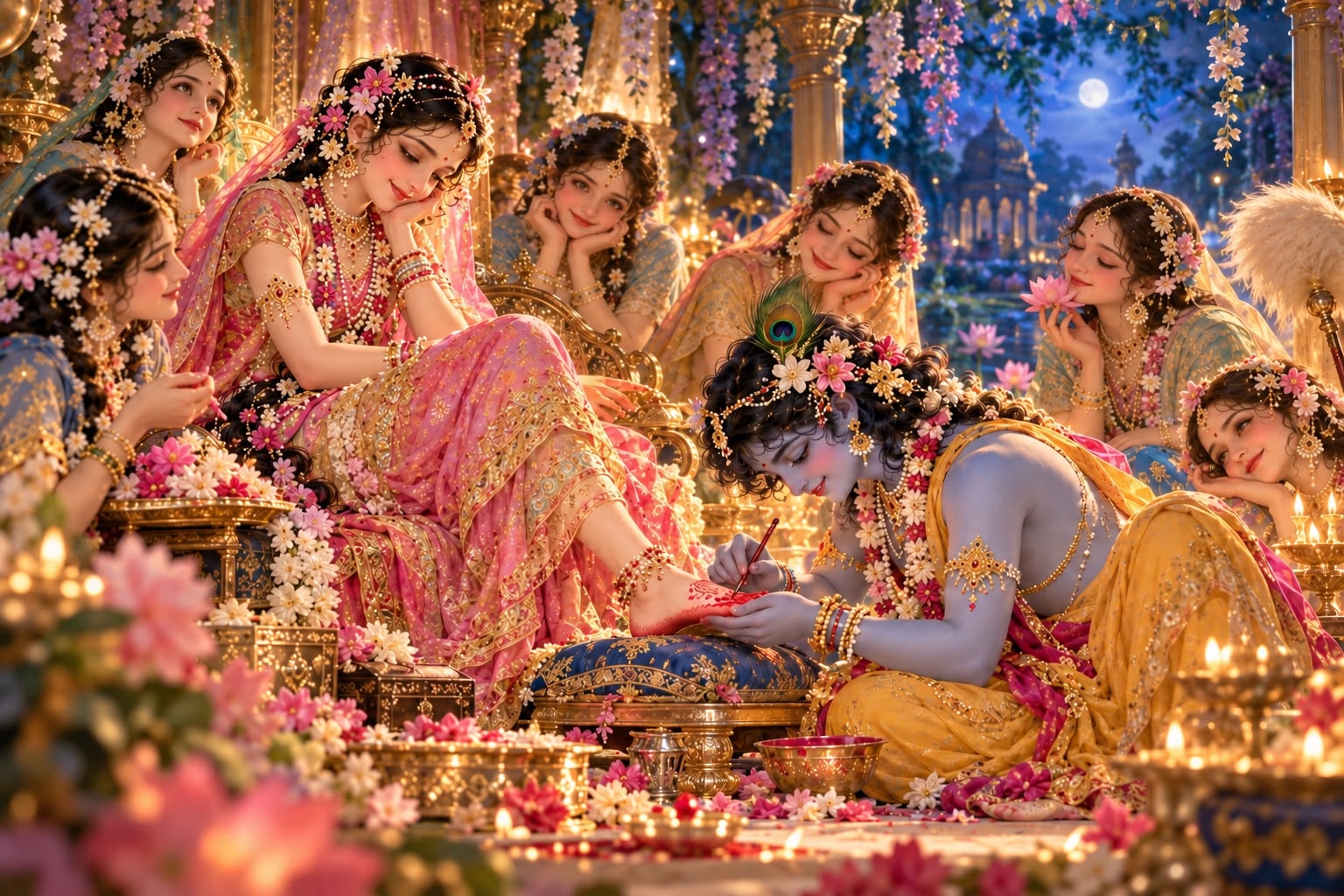
Sometimes Śrīmatī Rādhārāṇī will ask Kṛṣṇa to fix Her clothes and decorations after Their amorous pastimes. She will order Him to do so, then forbid Him from touching Her, and then order Him again.
Everything is in total disarray after Their intimate pastimes.
The clothes and ornaments that had been so carefully arranged by the mañjarīs are now scattered throughout the Nikuñja kuṭīra. Her long, curly hair, which takes great skill to braid and arrange so beautifully, is now loose and wild.
The bed of flower petals is as colorful as if Rādhā-Govinda had been playing Holī there, stained with the vermilion, sandalwood paste, and musk that had decorated Their bodies.
Even the red lac has disappeared from Śrīmatī’s feet.
Normally, this lac remains for days and does not come off easily, even with repeated washing. Yet somehow Śyāma has managed to remove it!
The sakhīs will certainly laugh and tease Her if they see Her in this condition—and they are already waiting outside.
Everything must be quickly restored to its proper place, or Rādhikā will become embarrassed.
“Start from My feet,” Rādhikā says when She is in Her svādhīna-bhartṛkā mood—the beloved who controls Her lover through love.
She is now Vṛndāvaneśvarī, and Kṛṣṇa must serve Her as His iṣṭa-devatā.
She lifts Her feet into His lap so that He can reapply the red lac.
But the moment Śrī Kṛṣṇa touches Her lotus feet, He loses Himself.
He begins to tremble. Tears flow from His eyes, and perspiration covers His body. He cradles those beautiful golden feet against His chest, like a dark raincloud embracing a flash of lightning.
His body sways, His eyes roll upward, and He is on the verge of losing consciousness.
Seeing what is happening, Tulasī Mañjarī pushes Him aside.
“Oh, Svāminī! Look—Your lover is not capable of this task! Come, we do not have time for this.”
Why does Kṛṣṇa faint simply from touching Her feet?
He touches Her transcendental body constantly—holding Her hands, kissing Her, embracing Her, enjoying loving pastimes with Her. At those times He does not lose consciousness. If He did, He would make a very poor lover!
The difference is that in those moments He is situated in the mood of Her lover, and this He can manage.
But when He tries to serve Her lotus feet, He enters the mood of a mañjarī.
And that mood is too high even for Him.
Kṛṣṇa Learns Sevā From the Mañjarīs
Kṛṣṇa often does quite poorly at His sevā for Śrīmatī.
He tries to braid Her hair, fix Her clothes, or arrange Her ornaments, and everything comes out a little clumsy.
But Rādhikā likes it very much.
In fact, She loves His imperfect attempts even more than the flawless work of Her mañjarīs and sakhīs.
And the mañjarīs love it too.
They love to see Kṛṣṇa expressing His love and devotion for their Svāminī.
Still, He tries to learn.
When He attempts to arrange Her clothes or braid Her hair, He looks toward the mañjarīs for some indication of whether He is doing it correctly. It takes Him a long time to accomplish even the simplest task, but He is always eager for the opportunity.
And when the mañjarīs are serving, Kṛṣṇa may watch carefully so that He can imitate them later.
He knows very well how dear they are to Śrīmatī Rādhārāṇī and how perfectly they arrange everything for Her pleasure.
But at the same time, the mañjarīs are also watching Kṛṣṇa.
This, too, is part of their sevā.
When Kṛṣṇa is not present, they can sometimes give Rādhārāṇī an experience that reminds Her of Him and helps ease the pain of separation.
Thus, Kṛṣṇa and the mañjarīs, although they do not have a direct relationship with one another, are always connected through their love for Śrīmatī Rādhārāṇī.
Both He and they are completely dedicated to one purpose:
to make Her happy.
Even Kṛṣṇa Wants to Become Rādhā-dāsa
It is the inherent nature of every living entity to become Kṛṣṇa-dāsī, the servant of Kṛṣṇa.
But only a rare few aspire to become Rādhā-dāsī, the maidservant of Śrīmatī Rādhārāṇī.
Even to have such an aspiration is itself a rare and precious gift.
Kṛṣṇa is Svayam Bhagavān, the Supreme Lord of all the worlds.
And yet, even He desires to become Rādhā-dāsa.
By the mercy of Śrī Gaurāṅga Mahāprabhu and Śrī Gurudeva, those of us trying to follow the path of rāgānugā-bhakti have been offered an opportunity that even the demigods can scarcely dream of.
We have this one short human lifetime in which to pursue it.
After this, we do not know.
So while we have this opportunity, let us devote everything we have to this goal.
And although that goal may sometimes seem impossibly high, we should remember that we are not pursuing it alone.
When we offer our body, mind, and heart to Śrī Gurudeva, he will take us by the hand and lead us directly to nikuñja-kuṭīra.
This article was inspired by the kathā of our Gurudeva, Prabhupāda Śrīla Premgopal Goswami.
It is merely an attempt by a low mind to approach a very high and confidential topic. Please therefore forgive any mistakes or shortcomings found within.
Our sincere hope is that these words may inspire you in your bhajana and encourage you to dive more deeply into the teachings of our Prabhupāda.
Jai Nitai!
Jai Śrī Rādhe!