

Jai Nitāi!
In our Paramparā, some prārthanā kirtans and bhajans are sung in a unique way. In particular, the Guru-vandanā written by Śrīla Narottama Dāsa Ṭhākura is sung in a different order from the original verses, and after each verse there is an ākhar, which is an explanation or expansion of the original line, following the same melody as the kirtans. This ākhar explains the inner meaning of the verses but flows so naturally that one does not recognize that anything has changed; it seems as if it is part of the original bhajan.
All these prārthanā kirtans and bhajans are sung in this way during the Śrī Śrī Guru-Niryāṇa Mahā Mahotsava at our temple in Śrīdham Navadvīpa: Gaurāṅga Bolite Habe, Śrī Kṛṣṇa Caitanya Prabhu Dayā Karo More, Nitāi Pada Kamala, etc. and even some ślokas like Śrī Rūpa-Pāśyate Āmi Rahibo from various scriptures.
When our Prabhupāda Śrīla Nityagopāl Gosvāmī, 14th-generation descendent of Śrī Nityānanda Prabhu, sings these bhajans, he sings them in a very beautiful melody and then gives the ākhar. Prabhu has mentioned many times that this is how he always heard them from his father, Prabhupāda Śrīla Madangopāl Gosvāmī, who in turn heard them from his own father in the same way.
This was started by Prabhupāda Śrīla Prāṇgopāl Gosvāmī, the 11th-generation descendant of Śrī Nityānanda Prabhu, but he did not make it up on his own. He received it in a very special way. Every day he would wake up and perform his āhnik at around 2:30 in the morning. On one occasion, it took him a very long time to complete His āhnik. His disciples were waiting outside, but at the usual time he did not come out of his room, and everyone began to wonder why. When he finally emerged, the devotees asked what had happened. He then explained that a divine personality had appeared to Him. He did not mention the name of this Personality, but our Prabhupāda Śrīla Nityagopāl Gosvāmī says — and many people believe the same — that this divine personality was Śrīla Narottama Dāsa Ṭhākura Mahāshay Himself, who appeared and instructed Him by personally singing this bhajan along with the ākhars. So from that day forward, in our paramparā, the Guru-vandanā has been sung with ākhars in this way.
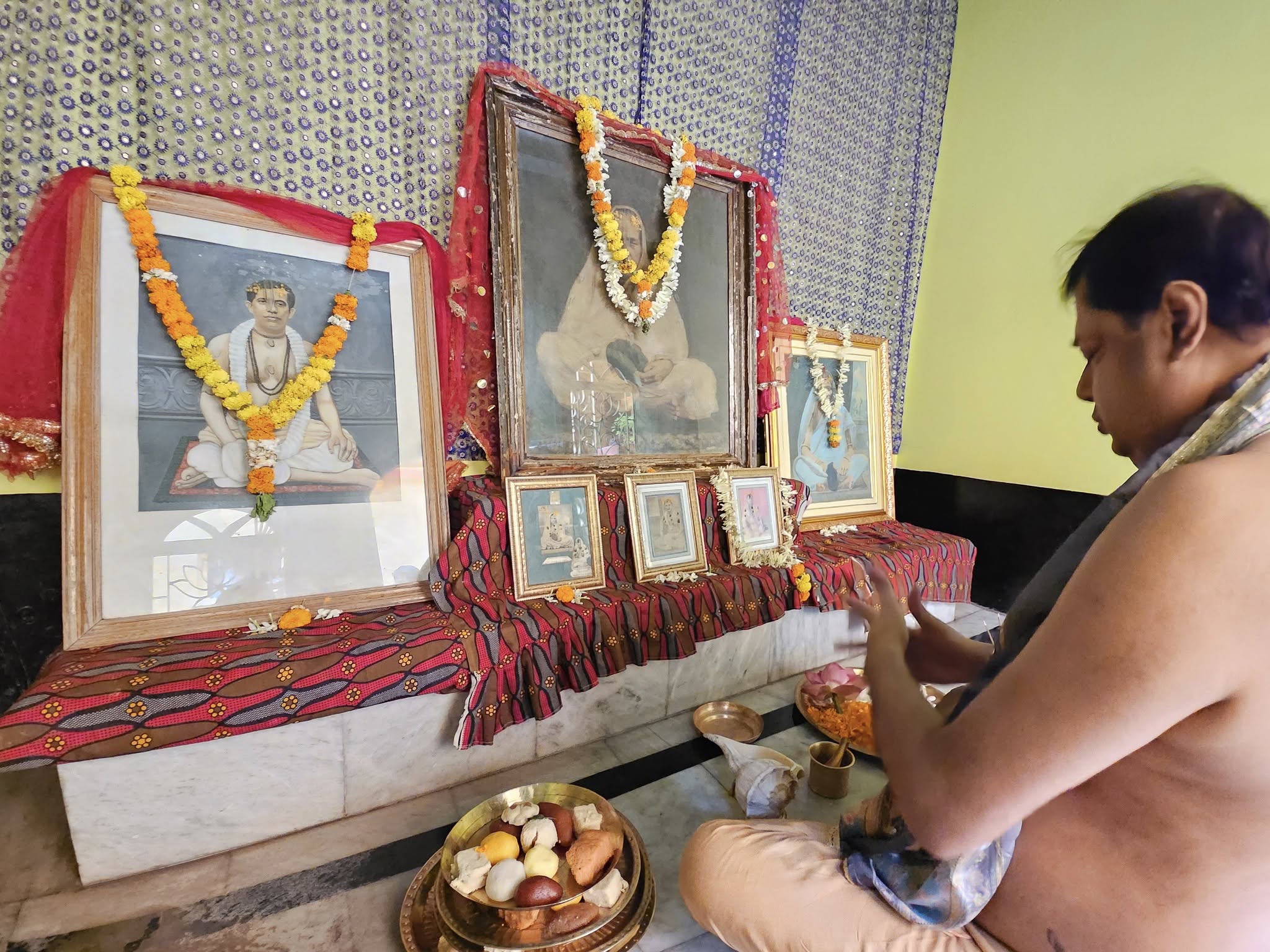
From around that time began the first Śrī Śrī Guru-Niryāṇa Maha Mahotsava, commemorating the disappearance of Prabhupāda’s Gurudevī and His mother, Śrīmati Śāradā Sundarī Mātā Gosvāminī. This was the first disappearance festival in the entire Gauḍīya Vaiṣṇava sampradāya to be observed on such a large scale, lasting around ten days straight. During this festival, Prabhupāda Śrīla Prāṇgopāl Gosvāmī began singing Guru-vandanā in this unique way in front of the samādhi-mandir, at our Śrī Śrī Rādhā-Madana-Mohana Temple in Śrīdham Nabadvīpa.
In Gauḍīya Vaiṣṇavism, each and every parivār /paramparā has their own special mood and way of practice. Although the prayojan [goal] is same, still we always follow the specific guidelines/practices according to our respective Guru paramparā. Through their bhajans, our ācāryas have presented to us on a golden platter the essence of all the scriptures, which cannot be realized even after studying for many years. The special inner mood and teachings of one’s own paramparā can only be understood through the bhajans and kīrtans sung by the ācāryas of that paramparā.
We mention this because, after hearing the kirtans sung in this way, following a different order, some people might think it is a mistake and that our paramparā does not follow the flow of verses as found in Prema-Bhakti-Candrikā. But it is not a mistake. This is how it was revealed to Prabhupāda Śrīla Prāṇgopāl Gosvāmī, and he was instructed by that divine personality to sing it in this way, with the ākhars, exactly as they are sung even today.
This practice was not invented by our Prabhus; it comes directly from the source, from Ṭhākura Mahāśaya, since most of these prārthanā kirtans and Guru-vandanā originated from him.
In this article, we will discuss Guru-vandanā as it is sung specifically during our Śrī Śrī Guru-Niryāṇa Mahotsava in Śrīdham Navadvīpa, in front of the samādhi-mandir. In other places, we may sing it in its original order, but every year during this festival it is sung in this way — because this is how it was revealed to Prabhupāda Śrīla Prāṇgopāl Gosvāmī, and how His descendants have faithfully carried on the tradition ever since. When one delves deeply into the meaning, it becomes clear that this order actually makes more sense, flowing in a very natural and coherent way.
Here we have included the original verses of Guru-vandanā, followed by the ākhar sung by Prabhupāda Śrīla Nityagopāl Gosvāmī during the Guru-Niryāṇa festival in 2025. This represents only one day’s ākhar — each day is a little different and spontaneous — but here most of the main points are covered. A link is provided below to the recording of that day’s kirtans. Please watch this video and listen carefully! Although we are presenting some translations for those who do not speak Bengali, actually the inner meaning and bhava of these verses can be realized only by hearing the words directly from Prabhu, by listening with open heart to the tone and the mood in which he sings.
☆After the original Bengali ākhar, a translation is provided along with some elaboration, to clarify the deeper meaning conveyed through Prabhu’s words.
[1] śrī-guru-caraṇa-padma, kevala-bhakati-sadma
bando mui sāvadhāna mane
Ākhar by Prabhu:
Sāvadhāne bandi tāre, āmi sāvadhāne bandi tāre
[Carefully, very carefully we must worship Śrī Gurudev.]
Śrī Guru kṛpā bhajaner mūla, sāvdhāne bandi tāre
[Guru kṛpā is the root of bhajan, so worship Śrī Gurudev very carefully and with complete faith.]
Bolo mūla chārā ki toru bāche, Śrī Guru kṛpā bhajaner mūla
Āmi sāvadhāne bandi tāre …
[Can a tree survive without its root? Similarly Sri Guru kripa is the root of Bhajana. That’s why we should worship His lotus feet very carefully.]
Dekho adbhuta prakāśa bhāire, sāvadhāne bandi tāre
[Oh brothers, look, such an astonishing manifestation of Śrī Gurudev!]
Eje Bhakta Bhagabān ekādhāre, adbhuta prakāśa bhāire
[Such a miracle of bhakta and Bhagavān combined together in one platform!]
Nā nā emon kabhu dekhi nāi he, bhakta Bhagabān ek ādhāre
[Such an astonishing manifestation cannot be seen anywhere in the entire existence except through the manifestation of Śrī Gurudev, where the form of sādhaka (practicing His own bhakti) and Bhagavān Himself reside together.]
Sudhu bhakta noy sudhu Bhagavān noy, bhakta Bhagavān ek ādhāre
[He is not only bhakta, not only Bhagavān, but both together in one form.]
Dekho jaga jibe uddhārite, bhakta Bhagabān ek ādhāre
[To deliver the conditioned souls, Bhagavān Himself appeared as a bhakta through the form of Śrī Gurudev in this material world.]
Jiber tritāp jālā dúr korite, bhakta Bhagavān ek ādhāre
[To free the living entities from their threefold miseries, this manifestation took place.]
Sakṣād haritvena samasta śāstrair, uktas tatha bhavyatā eva sadbhiḥ
Kintu prabhor yaḥ priyā eva tasya, vande guroḥ Śrī-caraṇāravindam
[7th verse of Śrī Gurvaṣṭaka of Śrīla Viśvanātha Cakravartī Ṭhākura, sung as part of ākhar]
Nikhila śāstra pramāṇe, Bhakta Bhagavān ekādhāre
[This conclusion is not some concoction or just emotion, it’s declared in all the scriptures.]
Āmār pāche aparādh ese jāi re, sāvadhāne bandi tāre
Ami sāvadhāne bandi tāre, pāche aparādh ese jāi re……
[Forgetting Śrī Gurudev’s aiśvarya, offensive mentality may arise in the future. Only by recollecting the lotus feet of Śrī Gurudev, can we save ourselves from committing offenses frequently. Let us worship Him very sincerely, very carefully, very dearly!]
Bando mui sāvadhāna mane
[End of ākhar for these two lines]
[1] The first line says that the lotus feet of Śrī Gurudev are very powerful. They are the storehouse of bhakti, kevala bhakti sadma. Not normal bhakti but kevala bhakti: pure, exclusive bhakti. Sadma means a storehouse. Worship very carefully (sāvadhāne), be very careful in everything having to do with Śrī Gurudev. Be well aware of the aiśvarya, the opulence of Śrī Gurudev.
Guru kripā bhajaner mul. Guru kṛpā is the root of bhajan. Mul means root. Without root, is it possible for the tree to survive? The very foundation of our bhajan is guru kṛpā.
Adbhuta prakāśa bhāire — O Brother, this is very wonderful! A very mysterious and astonishing thing, Śrī Gurudev! Śrī Guru Tattva! It’s not ordinary, it’s very special! What you see in front of you as Guru, you will never find something like this anywhere in the entire creation. There is nothing like this. Adbhuta means wonderful, miraculous, astonishing. Seeing Śrī Gurudev in front of us, we should feel like, my God! How is it possible? Sudhu bhakta noy sudhu Bhagavān noy. He is not only a devotee, he is not only Bhagavān, but something completely astonishing and unique. Elsewhere there may be Bhagavān, there may be devotees, but Śrī Guru is not only a devotee and not only Bhagavān. Adbhuta prakāśa bhāire, how can something so astonishing have manifested?
Bhakta Bhagabān ek ādhāre. Both of them together on one platform. Ādhar means a platform, foundation. As a devotee and as Bhagavān, both together combined on one platform. It’s very mysterious. How is it possible? And why has such a phenomenon appeared in this material world? To deliver all the conditioned souls, to shower causeless blessings on them. Only for this reason Śrī Guru has appeared.
In the ākhar, when Prabhu sings bhakta bhagavān ek ādhāre, he confirms it with that śloka from the Guru-aṣṭakam of Śrīla Viśvanātha Cakravartī Ṭhākura:sākṣād-dharitvena samasta-śāstraiḥ. He sings this to emphasize the point thatŚrī Gurudeva is not only bhakta and not only Bhagavān, but both together in one form.
In all śāstras, it is clearly mentioned that Śrī Guru is sākṣāt Hari, the Lord Himself, but then also kintu prabhor yaḥ priya eva. He is also very dear to Bhagavān, to Śrīmatī Rādhārāṇī. In what form? In his mañjarī-svarūpa, as an eternal maidservant. So it is a combination, not only one or the other. This is not just some emotion; he is giving the pramāṇa according to śāstra.
[2] yāhāra prasāde bhāi e bhaba-toriyā jāi
Ākhar by Prabhu:
Śrī Guru bhaba kāndāri……
[Śrī Gurudev is the helmsman]
Tomār nṛ-deha tāranite, Guru-bhaba kāndārī
Oi bhāva-sindhu tori bāre, Śrī Guru-bhaba kāndārī
[To cross over this ocean of material existence, Śrī Guru is the perfect helmsman for the boat of human life.]
nr-deham ādyam su-labham su-durlabha
plavam su-kalpam guru-karnadhāram
mayānukūlena nabhas-svateritam
pumān bhavābdhim na taret sa ātma-hā
[Śrīmad Bhāgavatam verse 11.20.17, sung as part of ākhar]
Swayam Bhagabān bolechen he
Oi abhinna tonu Bhāgavate swayam Bhagabān bolechen he
[Swayam Bhagavān Himself has said this in Śrīmad Bhāgavatam which is non-different from His own transcendental body.]
Oi amal pramān Bhāgavate swayam Bhagabān bolechen he
[Swayam Bhagavān Himself has said this in Śrīmad Bhāgavatam which is free from all faults and is the ultimate authority for everyone.]
Bolen Gurure kāndāri koro
Ei bhaba sindhu tori bāre, Gurure kāndāri koro
[Swayam Bhagavān said, “Accept Śrī Guru as your helmsman if you want to cross this ocean of material existence.”]
Jeno sei to āmār priyo hoy
je Gurure kāndāri loy, sei to āmār priyo hoy
[“Anyone who takes shelter and surrenders to the lotus feet of Śrī Gurudev, that person is very dear to Me.”]
Āmi anukul bātāśa bohāy di
Tāre āsu Bhaba torāite, āmi anukul bātāsh bohāy di
[“I will send favorable winds to help that person cross this ocean with ease.”]
Ogo tore jāo, tore jāo
[Oh my dear Sadhakas, seize as much mercy as you can, as much mercy as you can! Please get rid of this cycle called ‘birth and death’!]
Oi Gurure kāndāri kore, ei bār tore jāo, tore jāo
[By accepting Śrī Gurudev as your helmsman, get delivered in this very lifetime.]
Ābār mānob janam pāo ki nā pāo, ei bār tore jāo, tore jāo
[Who knows if you will get this rare human form again?]
Emon sadhak janam pāo ki nā pāo, ei bār tore jāo, tore jāo
Gurure kāndāri kore, bhaba sindhu tore jāo…….
[Even if you get this rare human birth next time, still what is the guarantee that you will do any sadhana? So get delivered in this lifetime!]
yāhāra prasāde bhāi, e bhaba-toriyā yāi
[End of ākhar for this line]
[2] Now for the second half of this verse. The original meaning refers to the one by whose mercy one can be delivered from this material existence: e bhaba toriyā jāi. We are all adrift in the ocean of material existence, this bhava sāgar, bhava sindhu. The one by whose mercy one can cross to the other side, this is Śrī Guru. Only by the mercy of Śrī Gurudev it is possible to cross over this material existence and this adbhuta prakāśa, this most miraculous manifestation, has come here for that purpose only, to deliver us from the cycle of birth and death.
Here in the ākhar, Prabhu sings, Guru bhaba kāndāri. Kāndāri means a helmsman, not just a sailor but an expert in navigating the open ocean, someone who can take you across from one shore to another. It’s not an easy thing to go sailing across the ocean. There are waves, sometimes very large and dangerous, wind coming and going. It’s very difficult to control the boat or even to know where you are supposed to go. Everywhere you look it’s only water in all directions. Ordinary people can’t do it, it’s not possible. Even with an excellent sailing ship, you will just go here and there at the mercy of wind and waves. You will never reach the shore.
Kāndāri bihin kabu tori kule jāy? se toh hethāy hothāy ghure berāy, bolo kāndāri bihin kabu tori kule jāy? Without kāndāri, without the expert helmsman, is it possible for anyone to cross the ocean?
Śrī Guru is that helmsman, not of any ocean of water but the ocean of material existence , bhava sāgar. In the material world, there are many sailors who can take you across even very wide seas. But we have been lost in this material existence from time immemorial, unable to find our way out. Only our Gurudev is bhava kāndāri, the helmsman who can take us across that ocean.
We all must understand how fortunate we are that we have gotten diksha. It’s not an ordinary thing. There is this sloka from Śrī Caitanya-caritamrta: dīkṣā-kāle bhakta kare ātma-samarpaṇa / sei-kāle Kṛṣṇa tāre kare ātma-samarpaṇa. (Antya-līlā 4.192) The moment we take initiation and surrender yourself (ātma-samarpaṇa) to Sri Gurudev, at that moment Krishna considers us as His own. Although we all are eternally connected to Him, we are His amśa, but until that time of initiation there is some distance. But the moment we recieve diksā and do ātma-samarpaṇa, then He says, “This person is Mine.”
In Śrīmad-Bhāgavatam (11.20.17), we can find this śloka: nṛ-deham ādyam su-labhaṁ su-durlabhaṁ …, It’s very rare to get a human body like this. It’s the perfect boat that we have now to cross this ocean of samsara. After getting this boat, if someone still does not accept a proper helmsman, Śrī Guru, then he is actually committing suicide, …na taret sa ātmā-hā. Without taking shelter of Śrī Gurudev, this precious human life is wasted. Krishna Himself is saying this in Śrīmad-Bhāgavatam which is non-different from His own body.
Somebody may ask, I have surrendered to Krishna, I am worshiping Him, is it really necessary also to surrender to a Guru? That sloka itself has the answer: mayānukūlena nabhas-svateritam. Krishna is saying, “When you take initiation, then I create favorable conditions for you.” If you are crossing the ocean, you must have an expert sailor to control the boat, but also it’s necessary to have favorable winds. Wherever you want to go, the wind must blow in such a way that it will take you there. If the wind is contrary, try as you might you cannot reach your destination.
That’s why Bhagavān is saying, if you accept Guru, then you will become very dear to Me and I will shower My special mercy on you. I will blow favorable winds. You are doing bhajan, I will give more power to you so that your bhajan will increase. But this is only to the one who accepts Guru. If even after receiving so much mercy, after being given a human body, if you don’t accept initiation and don’t even try to do bhajan, if you don’t make any attempt to cross this material existence, it’s like committing suicide.
In the ākhar here, Prabhu says ābār manav janam pāo ki nā pāo, ei bār tore jāo. Don’t think like “I have time, if I don’t do bhajan in this life I’ll do it the next time around.” You never know if you will get a human body in your next life — it’s very rare! Ei bār tore jāo, tore jāo. Please, get delivered this time! You have this human form now, don’t take it lightly! Otherwise, who knows when you’ll get another chance. Tore jāo, tore jāo!
And even if you get human birth again, what if you don’t get sādhaka-janam, a life favorable for practicing bhakti? There are so many human beings on this planet but how many of them are connected with dharma or bhakti? If you are not doing bhajan in this lifetime as a human being, then what is the guarantee that you will in the next lifetime? It might happen just the same way. Again, “I’ll do it next time.” So make use of it now. It’s not so much to do, just get attached to Śrī Guru, try to serve him, try to follow whatever he says. Of course, it must come in a proper paramparā, not accepting just anyone as Guru.
Those of us who have already taken initiation, we must always remember the importance of diksā, we belong to Them now. Because Guru has accepted us, Radha-Krishna has accepted us. Now we are Theirs. It’s not a question of whether or not They will accept us. No, we are accepted already, because we have been accepted by Śrī Gurudev.
[3] kṛṣṇa-prāpti hoy yāhā haite
Ākhar by Prabhu:
Śrī Guru kṛpā Kṛṣṇa prāpti hetu
[The mercy of Śrī Guru is necessary for attaining Krishna prema.]
Śrī Guru kṛpā hi Kṛṣṇa kṛpā
[Guru kṛpā itself is Krishna kṛpā.]
yasya prasādād bhagavat-prasādoyasyāprasādān na gatiḥ kuto ’pidhyāyan stuvaṁs tasya yaśas tri-sandhyaṁvande guroḥ śrī-caraṇāravindam
[8th verse of Śrī Guru-aṣṭakam of Śrīla Viśvanātha Cakravartī Ṭhākura, sung as part of ākhar]
Śrī Guru kṛpā hi Kṛṣṇa kṛpā
Āmār akṛpāte gati nāi he
[Without His mercy, no destination whatsoever is possible.]
oi guru kripā bihin jane, kothao sthān nāi he
[Those bereft of Śrī Guru’s kṛpā will never reach any destination.]
Tār narake o sthān nāi he
[There is no place for such a person even in hell.]
Nā gatiḥ kuto pi, tār narake o sthān nāi he
Śrī Guru kṛpāy Kṛṣṇa kṛpā, ābār akṛpāte gati nāi he
Śrī Guru’s kṛpā is Kṛṣṇa’s kṛpā, and without this there is no deliverance for anyone.]
kṛṣṇa-prāpti hoy yāhā haite
[End of ākhar for this line]
[3] We can get Kṛṣṇa Prema only by the mercy of Śrī Gurudev. After this, in the ākhar Prabhu sings, Guru kripā hi Kṛṣṇa kripā. We need Guru kṛpā to attain Kṛṣṇa or Kṛṣṇa prema. But more than that even, Guru kṛpā itself is Kṛṣṇa kṛpā and Kṛṣṇa kṛpā is Guru kṛpā. Guru kṛpā is the form in which Kṛṣṇa kṛpā comes to us, there is no other way.
This śloka from Guru-aṣṭakam is very much connected to this point:
yasya prasādād bhagavat-prasādo
yasya aprasādān na gatiḥ kuto ’pi
Śrī Guru is the one by whose mercy we receive the mercy of Bhagavān; Gurudev’s mercy is Kṛṣṇa’s mercy. If Gurudev is pleased, Bhagavān is pleased, but if Gurudev is not pleased, there is no gati, we will never reach our goal or any destination whatsoever. Yasya aprasādān na gatiḥ kuto ’pi. Not even in hell will there be a place for such person.
If Śrī Gurudev doesn’t shower His mercy on us, we may do whatever sādhanā you want—all day around and around the japa-mālā, so many parikramās, Rādhākuṇḍa snāna—but nothing will benefit us spiritually. Many people take dīkṣā (initiation) but still have independent mentality, trying to achieve through their own effort rather than samarpana. Saranagati, surrender, or complete attachment to Śrī Gurudev, means that he is my life and soul, and I try to follow each and every word that he says. This is what it really means to take dīkṣā.
Without this, we may do lots of bhajana, but still, instead of prema, our ahaṅkāra will increase. Meanwhile, another person might not do so much, but he is completely dedicated to his Guru. Just this firm faith will give him everything, even with little bhajana.
[4] cakşu-dāna dilā yei, janme janme prabhu sei
Ākhar by Prabhu:
Āmār janme janme prabhu sei
[Life after life, I belong to my Prabhu (Śrī Gurudev)]
Oi cākṣu dāna dilā jei, janme janme prabhu sei
[The one who opened my eyes, blinded by darkness of ignorance, with the light of transcendental knowledge — he is my lord life after life.]
E to dui ek janmer sambandha noy
[The relation between Śrī Gurudev and a disciple is not for just one or two lifetimes, we belong to Him eternally, having the most intimate connection]
oi prākṛta ātmiyer mata, dui ek janmer sambandha noy
tomār jagater ātmiyer mata, dui ek janmer sambandha noy
[This is not like some material relationship which we have in this world with parents, siblings, friends, or lovers. This particular relation between Śrī Gurudev and a disciple is above and beyond any material connections]
oi janme janme prabhu sei
oi sādhak janme, siddha janme, janme janme prabhu sei
[In our sadhaka body in this material world as well as in siddha svarūpa in the spiritual world, the relation between Śrī Guru and disciple is eternal. Life after life he is my lord!]
cakṣu-dāna dilā yei, janme janme prabhu sei
[End of ākhar for this line]
[5] divya-jñāna hṛde prakāśita
Ākhar by Prabhu:
Āmār sambandha gyāner uday koilen
[He revealed to me my eternal relationship with Bhagavān and showed me my eternal position.]
Oi param karun Śrī Gurudev, sambandha gyāner uday koilen
[My supremely compassionate and merciful Śrī Gurudev established sambandha-jñāna in my heart, knowledge of my eternal relationship with Him and with Bhagavān.]
Bollen ei tumi toh tumi nao he
[First he said that this body is not you.]
Tumi nijere jāhā bhābicho, ei tumi toh tumi nao he
[What you consider yourself is actually not you.]
Āmār sambandha gyāner uday koilen
Oi parama karuṇa Śrī gurudev, sambandha gyāner uday koilen
Tār karuṇā candrer kiraṇa prakāśe, sambandha gyāner uday koilen
[By his compassion like a cool ray of moonlight, he arose sambandha-jñāna in my heart.]
Oi gyāna-anjana śalākā diye, sambandha gyāner uday koilen
[By applying ointment of divine knowledge, he made me realize my eternal nature in connection with Bhagavān.]
Āmār patit dashā here, sambandha gyāner uday koilen
[Seeing my fallen condition, out of causeless mercy he bestowed knowledge about the constitutional position of a living entity.]
Koto ādor kore kāche deke, sambandha gyāner uday koilen
[With so much love and care, he was making me realize my eternal relationship.]
Harināma prema pradān kare, sambandha gyāner uday koilen
[By bestowing prema hidden in harinam, he made me realize my true identity.]
Śrī Gour Govinda ālāpane, sambandha gyāner uday koilen
[By narrating pastimes of Gaura and Govinda, he awakened sambandha-jñāna in my heart.]
Śrī Jugal bhajan upadeśe, sambandha gyāner uday koilen
[By advising and guiding me about how to perform Yugal-bhajana, he nourished my eternal identity.]
Oi mañjarī svarūpa nirupane, sambandha gyāner uday koilen
[By deeply explaining about mañjarī-bhāva, he infused my heart with the highest and sweetest transcendental knowledge.]
Bollen tumi Rādhā pada dāsi, sambandha gyāner uday koilen
[And then finally he said: you are the eternal maidservant of Śrīmatī Rādhārāṇī. This is how he made me realize my eternal relationship.]
divya-jñāna hṛde prakāśita
[End of ākhar for this line]
[4 & 5] Originally, in Narottama Dāsa Ṭhākura’s Guru-vandanā, the next line is guru mukha padma vākya…; But in our paramparā, we sing this guru mukha padma vākya and śrī guru caraṇe rati ei sei uttamā gati as the last two verses, because they are the most important, and through realization it actually makes more sense why this is the flow of verses in our paramparā. It is not something random. So now, skipping those two verses, comes cakṣu dāna dilo yei, janme janme prabhu sei.
Life after life, I am yours. I cannot live without you. I may or may not do bhajana, but I want that every time I am born, I will be your disciple. Every time I want to be in this paramparā. Sri Gurudeva is my Prabhu; he is my lord life after life. I don’t know anyone else.
The relationship with Śrī Guru is not like a material relationship. You may love so many people in this material world—mother, father, sister, brother, wife/husband, son/daughter, friends. There are so many different relationships. But this relationship between Guru and a disciple is not like any of those. It is not a connection of just one or two lifetimes, depending on karma and saṁskāras. It is janme janme, life after life. And not only in this material world! sādhaka-janme siddha-janme, janme janme prabhu sei. In the spiritual world, siddha-janme, still Gurudeva is with us. This is a relationship of the soul, not the body.
Before meeting Śrī Gurudev, I was blind. I was not aware of anything. Who am I? What is this world, what is my purpose here? Who is Bhagavān? Nothing. I was completely blinded by ignorance. After initiation, he gave me new eyes, the eyes of knowledge. He put light in my life. That darkness of ignorance in which I had been lost was eradicated by the knowledge he gave.
Maybe it seems like I already had so much knowledge before taking initiation, even knowledge about bhakti.
But there is no consideration of time in this eternal relationship between Guru and disciple. Even when you were not initiated yet, still everything that happened was by mercy of Śrī Gurudev. He was aware of you even when you weren’t aware of him. It may take some time until the point in this life when you get connected but time doesn’t keep you away from him. Janme janme, life after life
All this time, Gurudev was preparing you: making you meet this or that person, giving you the knowledge you needed, until the right moment came for you to take initiation. Always, he is the only one nourishing us, protecting us, giving us everything.
So how did he give us knowledge? How did he nourish and prepare us?
Tumi nijere jāhā bhābicho, ei tumi toh tumi nao he;He said, the way you consider yourself now, this is not who you are. You may think that “I’m a man, I’m an engineer, I’m this, I’m that,” but this is not really you. tomāra bhinna paricaya āche. You have a different identity, a very special one, but you don’t know about it! And when you understand this identity, you will feel very happy and proud! Now you have forgotten because of māyā, because you’ve been here in this false identity for so long. Your face was turned opposite to Bhagavān.
But then Gurudeva starts to reveal the truth — very slowly, with so much love and care. First he gives harināma, and in that nāma there is prema. He instructs us how to do bhajana, tells us about Rādhā-Kṛṣṇa, about Nitai-Gaura, and about our relationship with Them. sambandha-jñāner udaya koilen — just like the sun rises, slowly he caused sambandha-jñāna to rise within our heart. And finally, he revealed to us our eternal identity – tumi rādhā-pada-dāsī.
Only when we are prepared to understand what that means, he tells us that we are Rādhā-dāsī and reveal to us our mañjarī-svarūpa.
[6] prema-bhakti yāhā haite, avidyā vināśa yāte
vede gāya yāhāra carita
Ākhar by Prabhu:
Chāri mukhe gaan kare, Veda chāri mukhe gaan kare
[The Veda sings with his four heads.]
Oi preme dagamagi hoye, veda chāri mukhe gaan kare
[Swaying in bliss, absorbed in prema, the Veda is singing with his four heads.]
Tār Ṛg, Sām, Yajur, Atharva mukhe, chāri mukhe gaan kare
[By his four mouths — Ṛg, Sāma, Yajur, Atharva — the Veda is singing.]
Bollen guru tattva ati gudha tattva
[He says, “Śrī Guru tattva is the most mysterious tattva.”]
Guru tattva ati guru tattva
[“Śrī Guru tattva is a very guru (heavy) tattva.”]
Nā nā ere loghu koro nā he, guru tattva ati gudha tattva
[So don’t consider Guru tattva as something cheap. Don’t take it lightly.]
Eje abhinna Śrī Kṛṣṇa vigraha
Nā nā ere loghu koro nā he, abhinna Śrī Kṛṣṇa vigraha
[Gurudev is a non-different form of Kṛṣṇa. Don’t think he is an ordinary person; he is non-different from Śrī Kṛṣṇa Himself.]
ācāryam mām vijānīyān nāvamanyeta karhicit
na martya-buddhyāsūyeta sarva-deva-mayo guruh
[Śrīmad-Bhāgavatam 11.17.27]
Swayam Bhagavān bolechen he
Oi abhinna tanu bhagavate, swayam Bhagavān bolechen he
[Swayam Bhagavān Śrī Kṛṣṇa has Himself said this in Śrīmad Bhāgavatam which is non-different from his own transcendental body.]
Bollen āchāryam mām vijāniyāt, Śrī gurure āmi krishna jānibe
[He said, “Consider your Śrī Gurudev as Myself.”]
Dekho martya buddhi koro nā he, Śrī gurure āmi krishna jānibe
Śrī gurur sādhak svarūpa here, ere martya buddhi koro nā he
[When looking at Śrī Guru’s sādhaka-svarūpa, don’t think of him as a normal human being.]
Ohe gurur bhajan sādhan dekhe, martya buddhi koro nā he
Nā nā abamānanā koro nā he
Sarva devo mayo guru, abamānanā koro nā he
Sarva devo mayo guru, ere loghu koro nā he
[Never disobey or disrespect him. He is the representative of all the demigods. Don’t consider him lightly.]
Tumi ei caraṇe bikāye jāo
Sarva deva mayo Guru, tumi ei caraṇe bikāye jāo
[Sell yourself to his lotus feet.]
vede gāya yāhāra carita
[End of ākhar for this line]
[6] By the causeless mercy of Śrī Gurudev, we get prema-bhakti and then avidyā (ignorance) is destroyed completely.
After vede gāya yāhāra carita, Prabhu sings, veda cāri mukhe gāna kare. Originally the Veda is one, Mahārṣi Vedavyāsa has divided or classified it into four: Ṛg, Sāma, Yajur, Atharva. So that’s why it’s said here in the ākhar that the Veda is singing with his four heads. So this Ṛg, Sāma, Yajur, and Atharva are the four heads of Veda.
And with these four mouths, the Veda is glorifying Sri Guru. Guru-tattvaati-guḍha tattva means Guru tattva is a very secret and mysterious tattva. And also, Guru-tattvaati-guru tattva. Another meaning of guru is “heavy,” so Guru-tattva is very heavy. Don’t take it very lightly! Your own Gurudev is abhinna-tanu Kṛṣṇa-vigraha, non-different from Kṛṣṇa. He is Kṛṣṇa just in another form, present in front of you.
This also is found in Śrīmad-Bhāgavatam:
ācāryam mām vijānīyān nāvamanyeta karhicitna martya-buddhyāsuyeṭa sarva-deva-mayo guruh
(SB 11.17.27)
Bhagavān Himself is saying here: consider your Guru as Me. He is non-different from Me. Don’t consider him like a normal human being. Don’t think that he has an ordinary mortal body, don’t disrespect him. And then sarva-deva-mayo guruh — all the demigods are residing in Śrī Guru, and he’s non-different from Kṛṣṇa Himself.
Many topics will appear in one scripture or another, but in all four Vedas and all other scriptures you will find glorification of Śrī Guru and confirmation that he is non-different from Bhagavān.
[7] guru-mukha-padma-vākya
hride kori mahā sakya
Akhar by Prabhu:
Guru vākye dṛḍha viśvāsa rākho
[Have firm faith in the words of Śrī Guru.]
Tomār viśvāsa ei tomāy tarāy labe, guru vākye dṛḍha viśvāsa rākho
[Your strong faith in Śrī Guru’s words alone will deliver you.]
Jeno guru vākya Kṛṣṇa vākya
[Know that every word spoken by Śrī Guru is actually the word of Kṛṣṇa.]
Guru vākye dṛḍha viśvāsa rākho, guru mukha padma vākya
[Have complete faith in the words emanating from Śrī Guru’s mouth.]
Tomār sakala āśā puran habe
Śrī guru mukha padma vākya, tomār sakal āśā puran habe
Guru vākye dṛḍha viśvāsa rākho, sakal āśā puran habe
[If you have this firm faith in the words of Śrī Guru, then all your desires will be fulfilled.]
[8] āra nā kariha mane āśā
Akhar by Prabhu:
Nā nā anya āśā koro nā he
[Don’t desire anything unrelated to Śrī Guru.]
Tomār anya āśā hatāśā āni, tumi anya āśā koro nā he
[These desires for anything other than Śrī Guru’s mercy will only bring you misery. So don’t desire anything unrelated to Śrī Guru.]
Sudhu guru kṛpā bine ceho nā he
Śrī guru kṛpāi sarva siddhi, oi kṛpā bine ceho nā he
[By Śrī Guru’s kṛpā everything can be attained, so don’t set your heart on anything else.]
Tomār sakala āshā puran hobe
Śrī guru kripā baibhave, tomār sakal āśā puran habe
[By the opulence of Śrī Guru’s kṛpā, all your desires will be fulfilled.]
tomār sādhak janme siddha janme, sakal āśā purāṇa habe
[Everything you wish for in your sādhaka life as well as whatever seva you aspire for in your siddha deha, all will be fulfilled.]
Śrī gurur kripā baibhave, sakal āśā purāṇa habe
[End of ākhar for these three lines]
[7 & 8] Keep complete faith in the words of Sri Guru. Not “maybe yes, maybe no.” Never consider it lightly. Always keep that in your heart and remember everything that Gurudev has said, just as it is. Maybe at the time you didn’t understand but still, this was Gurudev’s word. Often when you think back after a long time, then you will see how deep and how true it really was. Every word that comes from his mouth has meaning, every word contains a great secret.
Guru-vākye dṛḍha viśvāsa rākho, ei viśvāsa tomāy torāy lobe. Only this viśvāsa, this firm faith in the words of Guru, will deliver you. You can sometimes meet devotees who are so simple, they don’t put any of their own intelligence between themselves and Gurudev’s word. Gurudev has said this, so that is the truth. Such devotees might not have any knowledge of scriptures but everything is revealed to them. They can listen just once to any deep topic and understand immediately, as their heart is completely prepared.
Bhagavān Himself makes arrangements for such devotees. You need some vidya, knowledge, to develop the proper mood. But for a devotee who has only Guru bhakti, even if they have no interest in reading scripture, Bhagavān will make sure that they get the knowledge somehow, either through the words of their Gurudev, through some other devotee, or it will be revealed internally within the heart. Bhagavān takes all responsibility for whoever is attached to Śrī Guru. Such a devotee doesn’t have to do much endeavor, as long as they have unflinching one-pointed viśvāsa.
Make the Guru’s words your life and soul. Forget about everything. Guru vākya, your world is that. My life is rotating on Gurudev’s vākya. So nothing else is there in your mind apart from Gurudev’s words. That becomes your life and soul.
[9] śrī-guru-caraṇe rati, ei se uttamā-gati
Ākhar by Prabhu:
ore ei toh tor uttamā gati
[This itself is your ultimate destination.]
Śrī guru caraṇe dṛḍha rati, ei to tor uttamā gati
[Deep, strong attachment to Śrī Guru’s lotus feet. This in itself is your highest perfection.]
tumi ei caraṇe bikāye jāo…
[Sell yourself at the lotus feet of Śrī Gurudev.]
Nā nā caraṇ cārā hoyo nā he, ei caraṇe bikāye jāo
[Don’t let yourself wander anywhere else, sell yourself at his lotus feet.]
[Attachment to Śrī Guru’s lotus feet is the ultimate goal.]
śrī-guru-caraṇe rati, ei se uttama-gati
ye prasāde pūre sarva āśā…
[End of ākhar for these two lines]
In our paramparā, we sing only until here with ākhars because this is how much was revealed to Prabhupāda Śrīla Prāngopāl Gosvāmī by the divine personality.
[9] There is no other destination or position than attachment towards Śrī Guru’s lotus feet. This attachment is your ultimate goal (gati). It’s not like if you are attached to your Guru, then you’ll reach perfection — no, this attachment is itself your ultimate destination. When you develop this attachment towards Gurudev’s lotus feet, this means that you are in that ultimate position.
Ei to tor uttamā gati, then tumi ei caraṇe bikāye jāo. Sell yourself at the lotus feet of Śrī Gurudev. Surrender, ātma-nikṣepa, throw yourself, sell yourself, you don’t belong to yourself anymore. And then all your desires will be fulfilled, whether in your sādhaka janme or siddha janme.
You may have many desires in your sādhaka body, like you may hear in other prārthanā kirtans: when will that day come that when I chant the holy names, tears will come from my eyes? Or maybe you may have the desire that I want to massage Gurudev’s lotus feet, I want to hug him, or I want to roam in Vṛndāvana by loudly singing kirtans and remembering all the pastimes taking place there, or maybe reside in Radhakund forever. All these desires which you have, everything will be fulfilled, and not only those which are related to sādhaka deha, also desires you may have in your spiritual body will be fulfilled.
Maybe in your siddha deha you yearn for the day when Śrīmatī Rādhārāṇī will personally call you by name and order you to massage her lotus feet, or maybe for the day when you are holding a spittoon for Śrīmatī Rādhārāṇī and then once nobody else is there, She looks around shyly and then calls you directly to Her and gives you Her tambūla prasāda, mouth to mouth.
Every desire will be fulfilled. This itself is the ultimate position, that you develop complete attachment to Śrī Gurudev, and all your desires will be fulfilled.
Conclusion
Our Prabhupāda Śrīla Prāṇgopāl Gosvāmī was a spiritual institution unto himself, an inspiration who ignited a spark of pure devotion and Vaiṣṇavism in the hearts of many. Not only a warm and humble Vaiṣṇava, he was a fearless patriot and a philanthropist. Chanting and distributing the holy names to spiritually uplift society, making people relish the Nāma-prema given by Nitāicand, doing kīrtan, sharing Harikathā, even becoming an essential part of the independence movement of the country—his contribution remains unparalleled.
If you would like to know more about Prabhupāda Śrīla Prāṇgopāl Gosvāmī and his life, a small drop of his miraculous, nectarean līlās can be found in the book Prabhu Prāṇgopāl Caritāmṛt Kaṇā, available through our website in original Bengali or English translation.
It is a privilege to get initiated in this Paramparā and to get even the slightest opportunity to serve the Guru Paramparā, as we have attempted to do here by presenting Guru-vandanā in the same way that our Prabhupāda received it from a divine personality. Reading and trying to understand even one nectar-filled syllable is a simple yet immersive way to realize and glorify Guru-tattva, to offer ourśraddhā, bhāva, and prema at the lotus feet of our Guru Paramparā.
May we always recollect their contribution and the sacrifices they made so that today we can rejoice in such soulful kathā, kirtans, parikramā throughout the week of the Śrī Śrī Guru Niryāṇa Mahā-mahotsava.
This work was only an attempt dedicated for the pleasure of our most glorious Nityānanda Vaṁśa Paramparā. Any mistakes within this text are ours; please forgive us for them. Take only what is good and reject the errors.
May we all remain forever surrendered and may their causeless merciful glance always fall upon us!
Śrī Guru-Paramparā kī jai!
Jai Nitāi!