1. Prabhupad Srila Prangopal Goswami
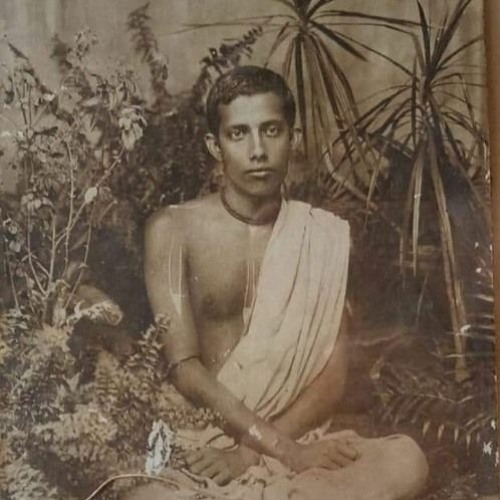
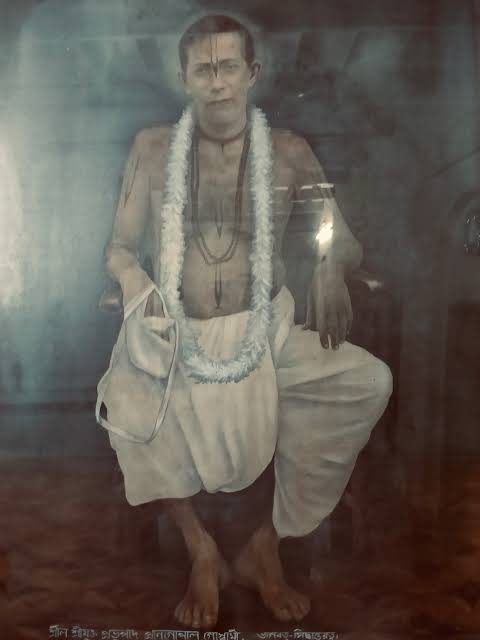
Prabhupada Srila Prangopal Goswami is the 11th direct bloodline descendant of Nityananda Prabhu. His life is full of miracles and supernatural events. He was an influential Ācārya and a prominent guardian of devotion at the turn of the last century. He is famous for his special style of harikatha (patha–kirtan), his settling the dispute over whether Harinam should be chanted silently or loudly, his reviving lila–kirtan, his organising the first cleaning of Radha Kund in modern times, his being an exemplary householder as well as a scholar and a charismatic preacher and, not least, for his books. A tiny drop of his glories, major contributions and miraculous pastimes are mentioned below.
He is the great grandfather of Prabhupad Premgopal Goswami and his paratpara guru. He appeared in 1876 in Butani village in the district of Dhāka, East Bengal (now Bangladesh). He concluded his manifest pastimes in 1941. He was merely four years old when his father Prabhupad Sri Alakmohan Goswami left his body. His mother and dīkṣā guru is Śrimati Śarada Sundari Goswamini (also referred to as ‘Kartamata’). After Prabhu Alakmohan passed away she had to struggle hard with poverty. A family friend and disciple of his father, Harendra Kumar Roy, gave them shelter in his village of Pacuriya in the Faridpur district and admitted Prabhu Prangopal to the local school (tola). At sixteen they moved to Kholabani where he studied the Vyakarana from Rajanibhanta Bhattacarya for two years. Then he went to Kolkata with his mother’s permission and continued studying under Sri Gokulcand Goswami and Sri Atul Krishna Goswami. He studied the Goswamis books as well classic poetry and dance. At that time he was so poor that he couldn’t even afford a candle lamp for his studies and therefore he used to sit and read under a gaslight in the street. Gokulcand Goswami was so pleased with his dedication, humility and his brilliant mind that he used to say, “This boy will preserve my name!”
He was born with very strong bhakti samskars (deep impressions from past lives). When he was eleven years old, his school friends induced him to go and see a famous dancer/singer. When he heard her singing a bhajan of Srimati Radharani in purva raga describing the beauty of Krishna, he had a vision of Krishna playing His flute and he fell unconscious to the ground. From that event onward he became detached from material aspirations and his attachment to bhakti has become prominent.
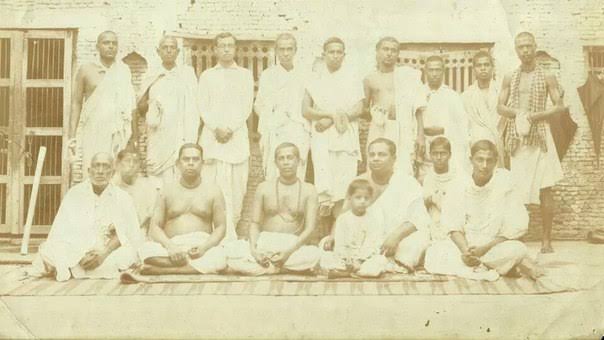
Later on, after becoming proficient in Sanskrit and Vedic scriptures he began to deliver harikatha discourses on Śrīmad Bhagavatam. He was ideally equipped for this because of his pure bhakti and his vast learning. At the end of his katha he would dance and sing lila kirtan. He is famous for reviving the tradition of Krishna lila kirtan and for introducing Gaura lila kirtan. His katha was so powerful that he very quickly became famous and attracted many people. Once he was giving Bhagavata katha in the village of Abadpur in Maimansimha district. Sri Anandakiśor Goswami of that village was so impressed by his katha that he offered him his daughter, Sarojini, in marriage. The Goswami’s family opposed this because Prabhu Prangopal was poor, but Sri Anandakiśor Goswami prevailed and Prabhu Prangopal and Sarojini Devi were duly married.
There was some dispute among the relatives of Prabhu Prangopal Goswami and as a result he left Kolkata and moved to Navadvip with his wife. He began to give Bhagavata patha (katha) and attracted many people as well as much opposition from the local smarta brahmanas who were envious of his success. They threatened him and even made attempts on his life but he was undeterred, having full confidence that Nitai would always protect him.
One old devotee, Govinda das Babaji of Vaiṣnavapaḍa was much impressed by his katha and they became close friends. One day, when Prabhu Prangopal was on his way to the Ganga, the Babaji invited him into his kutir. When Prabhu Prangopal saw the Babaji’s deities of Radha- Madanmohan he was struck with wonder. These were the same deities who revealed Themselves to him earlier on in life. That night both Prabhu Prangopal and the Babaji had the same dream whereby Lord Madanmohan revealed his desire to be worshipped by Prabhu Prangopal. Thereafter Govinda das Babaji handed over his kutir and Sri Radha- Madanmohan deities to Prabhu Prangopal and left for Vrindavan to do bhajan. In the course of time, the present temple of Radha-Madanmohan was constructed and later on Prabhu Prangopal also raised the money to build the neighbouring Radha-Govinda temple.
Every year, at the time of Niyam-seva (Kartik), Prabhu Prangopal went to Dhaka for the whole month to give Bhagavat katha. People came from far and wide to listen to his katha and became ecstatic to see him dancing and performing kirtan after the katha. Once he was giving katha at the house of a rich landlord, Kala Saheb in Kumilla. Prabhu Prangopal was speaking with deep bhava and the listeners were shedding tears but then a puffed up, highly placed official started interrupting the katha with inappropriate, challenging questions, much to the annoyance of everyone. Finally Prabhu Prangopal reproached that man sharply, “You should keep silent for now.” Instantly that man lost his voice and despite all his efforts couldn’t utter a single word. At the end of the katha Prabhu Prangopal touched that man’s forehead with his bead bag and restored his power of speech.
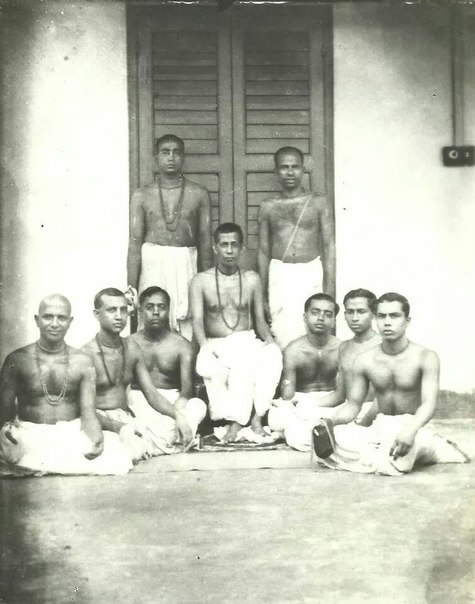
Once Prabhu Prangopal went to Falehabad for giving harikatha. In the nearby village of Mekala lived a rich man called Govinda Saha. On his property was a dilapidated temple built by his ancestors. The temple was haunted by a ghost. One day Govinda Saha picked up courage and asked the ghost, “Who are you? Why are you haunting us here?” The ghost replied, “I am one of your ancestors and I have been cursed to become a ghost. But I have good news for you. Sripad Prangopal Goswami is giving katha in Falehabad. You should go and take shelter of him by accepting dikṣa. Then you should bring his adarāmrita (his prasadam remnants) and offer it to me. By this I will be released from this curse.” Govinda Saha followed these instructions and the ancestor ghost was duly delivered.
Once, while delivering Bhagavat katha at the palace of Raj Nandi Mahaśaya of Kasimbazar, Srila Narottam das Thakur appeared to him in a dream and instructed him to go and give katha in Kheturi gram, the site of the famous kirtan festival initiated by Jahnava Ma. Thereafter the Pandits of Bengal assembly, being highly impressed by his katha and learning, awarded him the title Siddhanta Ratna (The crown jewel of those who know and propound the essence Vaiṣnava philosophy).
In 1911, Prabhupad Srila Prangopal Goswami went on pilgrimage to Vrindavan. The local devotees much appreciated the opportunity to hear his patha–kirtan. They took him from the station to his own LakṣmiKanta kunj temple in Gopinath bazaar in a kirtan procession with fourteen mridangas. The patha (katha) started the next day at the Govindaji temple. All the siddha mahatmas of the time attended including Pandit Ramakrishna das Babaji, Jagadish das babaji, Gauranga das Babaji and Rajarṣi Banamali Roy. When he described Vraja-lila, it was as if the lila had manifested. Devotees in the audience were stormed with bhava and manifested the symptoms of tears, horripilation and shaking.
Prabhu Prangopal had great capacity for controlling his bhava, but sometimes even he couldn’t control it. Occasionally, he had to stop the patha half way through and go to his private room to let his mind swim freely in the ocean of bhava of Vraja-lila. Once he became so deeply absorbed in bhava that the whole night, while sleeping, he continued reciting ślokas from Gopi-gita. The next morning, when his son, Prabhupad Srila Yadugopal Goswami asked him about it, he looked at him perplexed and said, “What are you saying? I can’t remember anything.”
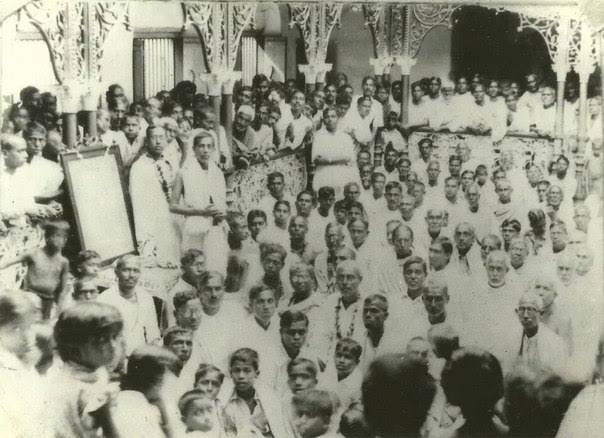
From Vrindavan, Prabhu Prangopal went to Radha kund. He used to circumambulate Radha kund a few times during mangal arati time (a tradition followed nowadays by Srila Prankrishna Baba). One early morning Prabhu Prangopal went out of site of his companions. Suddenly they heard him shouting, “Oh, come and see!” They ran up to him and found him lying senseless on the bank of the kund. The place was radiant with a supernatural blue light and pervaded by supernatural fragrance. They took him in unconscious state to the Rajbari residence of Rajarṣi Banamali where he was staying (it is situated on the left of Radha Kund parikrama marg, half way between Jaganath Mandir and Lalita kund, but is very run down nowadays). Prabhu Prangopal came back to half-external consciousness only after his companions sang Harinam to him for a long time. He looked at them with tearful eyes and said, “Oh my friends tell me where He has gone leaving me alone in the darkness of separation.” He continued to cry and rave in transcendental madness for a long time.
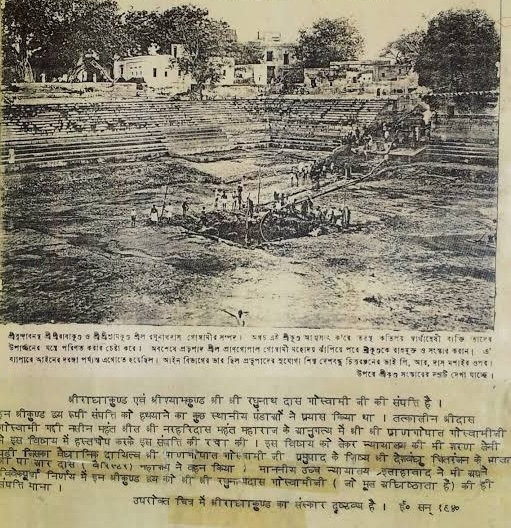
There are many more pastimes but I will only mention one more, the cleaning of Radha Kund. At that time it hasn’t been cleaned for hundreds of years and its condition was deplorable. Its water had become so muddy that it wasn’t even possible to take acaman, a few drops of caranamrita of the sacred liquid form of Srimati Radharani. Prabhu Prangopal was upset to see the kund in this condition and it brought tears to his eyes. Therefore he became determined to have it cleaned and renovated. This was a momentous task and involved a huge expenditure. But he was undeterred by the difficulties and started begging donations from door to door. He was helped by Sri Ramdas Babaji Maharaja and when some funds were raised the work started. At that point one local king claimed that Radha kund and the adjoining lands belonged to him. The case was brought to the High Court and Prabhu Prangopal’s disciple, the famous barrister PR Das, fought the case on behalf of the Gaudiya Vaiṣnavas and won it. The work was suspended for seven months and the money was spent. Prabhu Prangopal asked his wealthy disciple Priyanath Paul to undertake the financial responsibility for completing the work. Priyanath refused but that night Radharani appeared to him in his dream and reprimanded him for disobeying his Guru. The next day he apologised to his Guru and the work resumed. Radharani could not remain indifferent to the work undertaken by Her dear devotee, Her intimate maidservant, for Her own service.
Prabhu Prangopal also set the example of an ideal householder. He took great care of his family and once even agreed to Sanidev’s request to do puja for him in order to save the life of his seriously ill daughter. He considered Sri Radha Madanmohan the head of the household and whenever he got money he was anxious to spend it on devotional projects like building a temple or printing books. He never kept money for himself or for his family’s future.
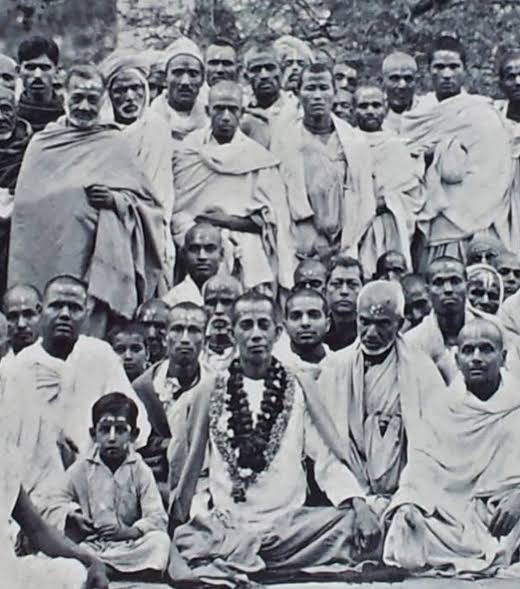
His contribution to the kirtan tradition is outstanding. Not only had he revived the lila–kirtan tradition, but he also introduced Gaura-lila kirtan. He trained all the prominent kirtaniyas of his time. He heard their kirtan and corrected it where it run counter to rasa–siddhanta. He changed the language where necessary and taught them the appropriate melody and dance by singing and dancing himself. He himself composed songs, both lyrics and melody, a tradition followed by Prabhupad Srila Madangopal Goswami and now by Prabhupad Nityagopal Goswami and Prabhupad Premgopal Goswami.
Prabhu Prangopal is a siddha mahatma, a fully realised, perfected soul. His ultimate glory is that he is an intimate manjari maidservant of Srimati Radhika. In our present state of consciousness we cannot realise this but there is circumstantial evidence. The following excerpt is from the biography of Kamini Kumar Ghosh: “Śrīpad Prangopal had deep respect and friendship with Kamini Bapu. Both addressed each other as ‘Dada’ (Elder brother). Though they lived far from each other, they often found themselves together in lila–smaran. Sometimes both envisioned the same lila and saw each other in their manjari svarupa. This is confirmed by the letters they wrote to each other.”
Even while sleeping at night Prabhu Prangopal was often heard saying something which indicated he was having lila–darshan. Once he was heard saying, “Oh sakhi, give me the camara (Yaktail fan). Don’t you see that both of Them are sweating?” This is not surprising because according to the siddha–pranali Prabhu Prangopal in his eternal manjari svarupa has the main service of fanning the Divine Couple.
Prabhu Prangopal’s most prominent contribution is to the Gaudiya Vaiṣnava literature. He translated Srila Jiva Goswami’s Sandarbhas into simple Bengali. He wrote a commentary on Caitanya-caritamrita (the Adi lila part has recently been reprinted and we hope to translate it into English). His favourite ācārya was Viṣvanath Cakravartipad and he translated many of his books into Bengali: Bhaktirasamrita-sindhu bindu, Ujjvala-nilamani kiran, Bhagavatamrita-kana, Raga-vartma-candrika and others. It is surprising that in spite of his many duties and preoccupation with preaching he found the time to translate and publish so many books.
Prabhupad Srila Prangopal Goswami and Bhaktisiddhanta Sarasvati were contemporaries but as far as we know they have never met. However, they had mutual friends like Pandit Ramkrishna das Babaji, so they must have known about each other. I mention this point because there is a sad history of a hundred years of the Gaudiya Math criticizing the Traditional Parivars and propagating false propaganda, claiming that the Traditional Gaudiya Vaiṣnava lines were stagnant at that time and that even now they are all “sahajiya Babajis.” Prabhupad Srila Prangopal Goswami’s life and teaching, and the life and preaching of his illustrious descendants, provide conclusive evidence that the opposite is true. It is therefore important to become familiar with Prabhu Prangopal’s Biography and to share this with others. The full Biography titled “Sri Sri Prangopal Charitamrita Kana” (written in Bengali by Madangopal Goswami) is available in English and in Spanish in both paperback and PDF forms. Jay Nitai!
2. Sri Biracandra Prabhu
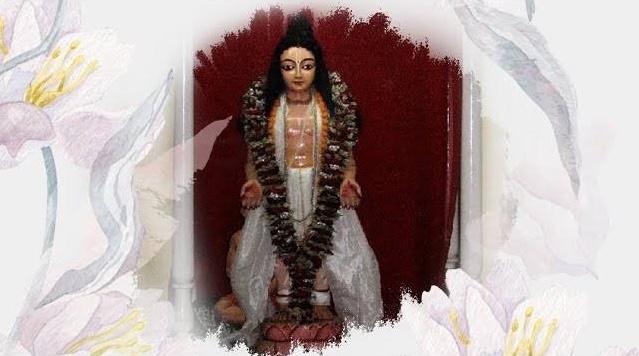
The most merciful saviour of the fallen souls of the age of Kali, Sri Krishna Caitanya Mahaprabhu, has appeared on the earth with all His associates to taste His own sweetness, to bestow Vraja prema and to distribute the dharma for this age of Kali – Sri Harinam Sankirtan. Soon after concluding His manifest pastimes as Sri Gauracandra, He manifested again in the form of Prabhu Biracandra to continue His Sankirtan mission.
Prabhu Biracandra came to protect, preserve and continue the line of pure Vaiṣnavism established by Sri Sri Nitai Gaur Sitanath (Nitai-Gaura and Advaita Acarya).
On the order of Sriman Mahaprabhu, Prabhu Nityananda accepted the grihastha ashram (household life). He married the two daughters of an inhabitant of Śaligram, Sri Surya das Pandit. Thereafter, Nityananda Prabhu established His residence (śrīpāt) in Khardaha where Prabhu Biracandra was born.
Sri Ganga Mata appeared on the saptami (7th) day of the lunar fortnight and Prabhu Birchandra on the ashtami (8th) during Kartik.
Prabhu Biracandra’s pastimes are described in Sri Caitanya Caritamrita (Cc Ādi-līlā 11.8–12), Sri Gaura Ganodesh dipika, Sri Abhiram lilāmrita, Sri Vamsi Siksha, Sri Murali vilas, Sri Narottam Vilas, Sri Bhakti Ratnakar and Sri Prem Vilas.
Prabhu Biracandra’s second wife Srimati Devi gave birth to three sons: Sri Gopijanavallabh, Sri Ramkrishna, and Sri Ramchandra. According to Vaiṣnava Dig-darśini, Biracandra Prabhu and Srimati also had three daughters: Naradurga, Navagauri, and Bhuvana-Mohini. The oldest son Sri Gopijanavallabh prabhu settled at Latagadi, the second son Sri Ramakrishna prabhu established his śrīpāt at Maldaha and the third son Sri Ramacandra Prabhu remained in Khardaha. An inhabitant of Phuliya gram, Parvaticaran Mukharji, married Srimati Bhuvana Mohini, Biracandra’s daughter. Sri Ramacandra Prabhu married Srimati Govinda Priya. Their son Sri Radha-Madhava married Srimati Kadamba-mala, the daughter of Jagadananda Pipali of Mahesh and they had four sons named Rama-deva, Krsna-deva, Visnu-deva and Radha-Raman, and a daughter Tripura Sundari.
Srila Devakinandana das describes in his Vaisnava Vandana:
“I worship the all merciful Sri Nityananda Prabhu, His dancing and singing is the source of all bliss.
I worship the two goddesses Vasudha and Jahnava, Their son Birachandra is glorified all over the universe.
With great care I worship Biracandra Goswami; all the residents of the world are under his shelter. (The three persons described below are the sons of Prabhu Biracandra and Srimati Viṣnupriya)
Very attentively I worship Sri Gopijana-vallabha, His wonderful characteristics are indescribable.
I will respectfully worship Sri Rama-Krishna Goswami; the deliverer of the souls, who possesses many wonderful qualities.
With steady mind I worship Sri Ramacandra Goswami; his unending qualities are described all over the universe. (Prabhupad Premgopal Goswami line descends from this Sri Ramacandra Goswami)
I worship the daughter of Lord Nityananda, Sri Ganga Thakurani; the earth is filled with the descriptions of her fame.”
Prabhu Nityananda had two wives, Vasudha and Jahnava. Srimati Vasudha Mata had one surviving son, Sri Biracandra Prabhu, and a daughter, Ganga Mata Thakurani. Prabhu Biracandra had two wives, Narayani Devi and Srimati Devi. He had his three sons, Gopijana-vallabha Prabhu, Ramakrishna Prabhu and Ramacandra Prabhu, and one daughter, Bhuvana-mohini Devi.
Gopijana-vallabha Prabhu had three sons. Bhuvana-mohini Devi married a resident of Phuliya, called Sri Parvati-charan Mukharji. This has been described in Sri Narottam Vilas as follows:
“Gopijanavallabha Prabhu had three sons: The oldest, Sri Ram-narayan, was the storehouse of all good qualities. Sri Ram-lakshman was the middle son and the youngest son was the compassionate Sri Ram-Govinda”.
The six sons of Prabhu Nityananda died one by one soon after birth because of the dangerous pranam (obeisances) offered to them by Sri Abhiram Thakur. (Abhiram Thakur’s obeisances were so powerful that they would kill anyone who wasn’t an eternal associate of the Lord).
Before disappearing, Sriman Mahaprabhu told Abhiram Thakur, “After my disappearance I will take birth in the house of Nityananda Prabhu and through your pranam it will be revealed which child is truly My Direct manifestation.”
Abhiram Thakur is Sridham Sakha in Vraj lila. He appeared in Bengal in his own original Vraj form and manifested his pastimes in Krishna Nagar in the district of Hugali. Abhiram Thakur had a special potency. He would bow down before the deities with such devotion that his power would cause them to shutter to pieces if they were idols and not real manifestations of the Lord. The obeisances of Abhiram destroyed many false deities in Bengal and only the deities of Sri Madan Mohan from Vishnupur and Sri Krishna Roy from Bagari withstood his obeisances. In a similar way he made the first six sons of Nityananda Prabhu die soon after birth. Only the seventh son, Prabhu Biracandra, survived Abhiram Thakur’s obeisances, thus proving to be the direct manifestation of Lord Gauranga. Prabhu Birachandra was the eight child of Nityananda Prabhu and Vasudha Mata. The seventh child was a daughter, Srimati Ganga Thakurani.
In the same way, only Srimati Ganga Thakurani, Sri Raghunandan Prabhu and an inhabitant of Puri, Sri Gopal Guru Goswami, survived Abhiram Thakur’s obeisances (thus proving to be eternal associates of Mahaprabhu).
(Prabhupad Premgopal Goswami: “ When Abhiram Thakur bent down to the floor to pay his obeisances to the newly born Biracandra Prabhu, baby Biracandra kicked him so hard on his head that the stout Abhiram Thakur was thrown back flat on the floor. When he got up he started dancing in ecstasy.”)
Because Sriman Mahaprabhu had hinted to Prabhu Nityananda that he would take birth in His house, Abhiram Thakur came every time to offer his obeisances to each newly born son and watched them leave their bodies. In this way Nityananda Prabhu and Vasudha Mata’s first six sons left this world soon after birth.
When Abhiram Thakur heard of the birth of Sri Biracandra, he came immediately to Khardaha to test whether his Lord Gauranga has reappeared. This is described in Sri Nityananda Vamsa Vistar, Second Stava: “A shimmering light was inundating the house, by seeing this, Abhiram became very excited. He at once fell at the lotus feet of the newly born baby boy and offered his obeisances while staring at him. In this way he repeatedly fell to the floor like a stick three times. Baby Birachandra Prabhu woke up from His yoga-nidra (mystical slumber) and smiled at Abhiram Thakur. I surrender at the lotus feet of that beloved baby boy Birachandra.
In this way Sri Gauranga manifested in the form of Biracandra, the enchanter of the world. Let the fortunate ones see His dancing and singing to increase their eagerness to come to Him.
Hearing of the Lord, one blind man came longing to see Prabhu’s Sankirtan. Upon hearing the kirtan he became ecstatic and desired to see the sweet form of the Lord. Being affectionate to his devotee, Biracandra Prabhu, who resides in the hearts of all living entities, understood the desire of the blind man and fulfilled it by giving him back his eyesight and allowing him to take the darshan of his sweet form dancing and singing.
In this way Prabhu Biracandra preached in a very loving manner and delivered thousands of fallen souls, there was no limit to the number of spirit souls he delivered. He preached eternal dharma (Sanatan dharma) which is beyond all material desires and beyond the mode of goodness.”
ye na dekheche gora, dekha ara bar, punarbar sei gora vira avatar
“One who has not witnessed the supreme Lord Caitanya, now has the opportunity to behold Him again, as the same Lord has now appeared as Sri Birachandra Prabhu”
In the course of preaching, Prabhu Biracandra went to the village of Khandara where one of his disciples called Jai Gopal lived. Jai Gopal was rejected by Biracandra Prabhu because he claimed he was a direct disciple of Nityananda Prabhu. This is described in a letter Prabhu Biracandra wrote to Srinivas Acarya telling him about this Jai Gopal. This letter is recorded in Bhakti Ratnakar:
“Jai Gopal das, an inhabitant of Khandara gram, has a big false ego and doesn’t know guru tattva. He has a very low nature. I have given him mercy (diksha) and despite this he desires something else. For this reason I have rejected him.”
One pastime involves the origin of the Syamasundar deity in Khardaha. The local Muslim king wanted to test Biracandra Prabhu’s power. Three times in a row he sent a tray of cooked food containing meat covered with cloth (with the intension to contaminate the devotees). However, again and again, when the cloth was removed, the contaminated food turned out to be a tray full of flowers like Malati (Jasmin) and Yuthi. Then that Muslim king fell at Biracandra Prabhu’s feet and surrendered to him. He asked Biracandra Prabhu to accept a gift from him as dakshina. Biracandra Prabhu asked for the centre stone of the gate of the local Mosque. From that special stone he made three deities and installed them: Syamsundar in Kardaha, Sri Nandalal in Saibona and Sri Radha-Vallabhji in Mahesh. Prabhu Biracandra installed the Syamasundar deity in Khardaha śrīpāt and then toured Gaudadesh (the land of Gaura) to preach the dharma of love.
The following pastime is described in Sri Nityananda Vamśa Vistar. It involves the twelve hundred Buddhist disciples called the Naras who came to Prabhu Birchandra’s house and asked for prasadam. They were very austere, celibate (brahmacaris) and had mystic powers due to their intense sadhana. Being independent, they disregarded Ma Jahnava’s request to wait for prasadam. Because the prasadam was late (being delayed because of their large number) they became angry and set the Syamsundar’s temple on fire with their yogic power. Consequently, Biracandra Prabhu used his mystic powers and manifested thirteen hundred women called ‘Naris’ to seduce the Naras and diminish their power. Those Naras that were bewildered by Biracandra’s deluding potency fell into illusion, took one or two women each and became householders called ‘bhrashtacharis‘ (defaulting on the sadacar of their brahmacari (renunciation) vows). They became known as ‘Sanyogis’ (the opposite of Sannyasis). Those that did not fall into Biracandra Prabhu’s illusion took shelter of him, became his disciples and helped his preaching efforts.
In this way Biracandra Prabhu chastised the Naras. Some of them understood and accepted his chastisement as his mercy. Wanting to advance in spiritual life, they made an ashram in a village called Nari Kumbharini. There they worshipped Bhakti Devi and consequently attained perfection in spiritual life.
Another pastime involves Śrinivas Acarya’s son. One day Prabhu Biracandra went to the house of Śrinivas Acarya at Viṣnupur. Srinivas acharya was very happy to receive Prabhu at his house and arranged for the paraphernalia to welcome Prabhu in an appropriate way including a variety of foodstuffs for preparing prasad. Seeing this Biracandra Prabhu said, “Your younger wife should cook.”
Srinivas Acarya’s younger wife Padmavati Devi, cooked the prasadam. After accepting prasad, Biracandra Prabhu lied down to take rest. At that time Prabhu asked Śrinivas, “Does your wife have children?” Śrinivas Acarya replied: “You have bestowed your mercy upon us. You gave your chewed betel nuts to my wife and soon afterwards she became pregnant and instantly gave birth to a son, Sri Gati Govinda. In this way Prabhu Biracandra caused the miraculous birth of Śrinivas Acarya’s son.
Prabhu Biracandra manifested so many such miraculous pastimes. Thus he established the dharma of pure love (visudha bhakti dharma) which is beyond the mode of goodness and culminates in the attainment of spiritual perfection in the form of Krishna prema.
The character and pastimes of Biracandra Prabhu are described in many old books, including Sri Prem Vilas written by Sri Nityananda das (Jahnava Ma’s disciple). He has written about Prabhu Biracandra in a very special manner. It is stated there that if one is sincerely interested in following the path of pure bhakti, one should know about Biracandra Prabhu’s pastimes.