

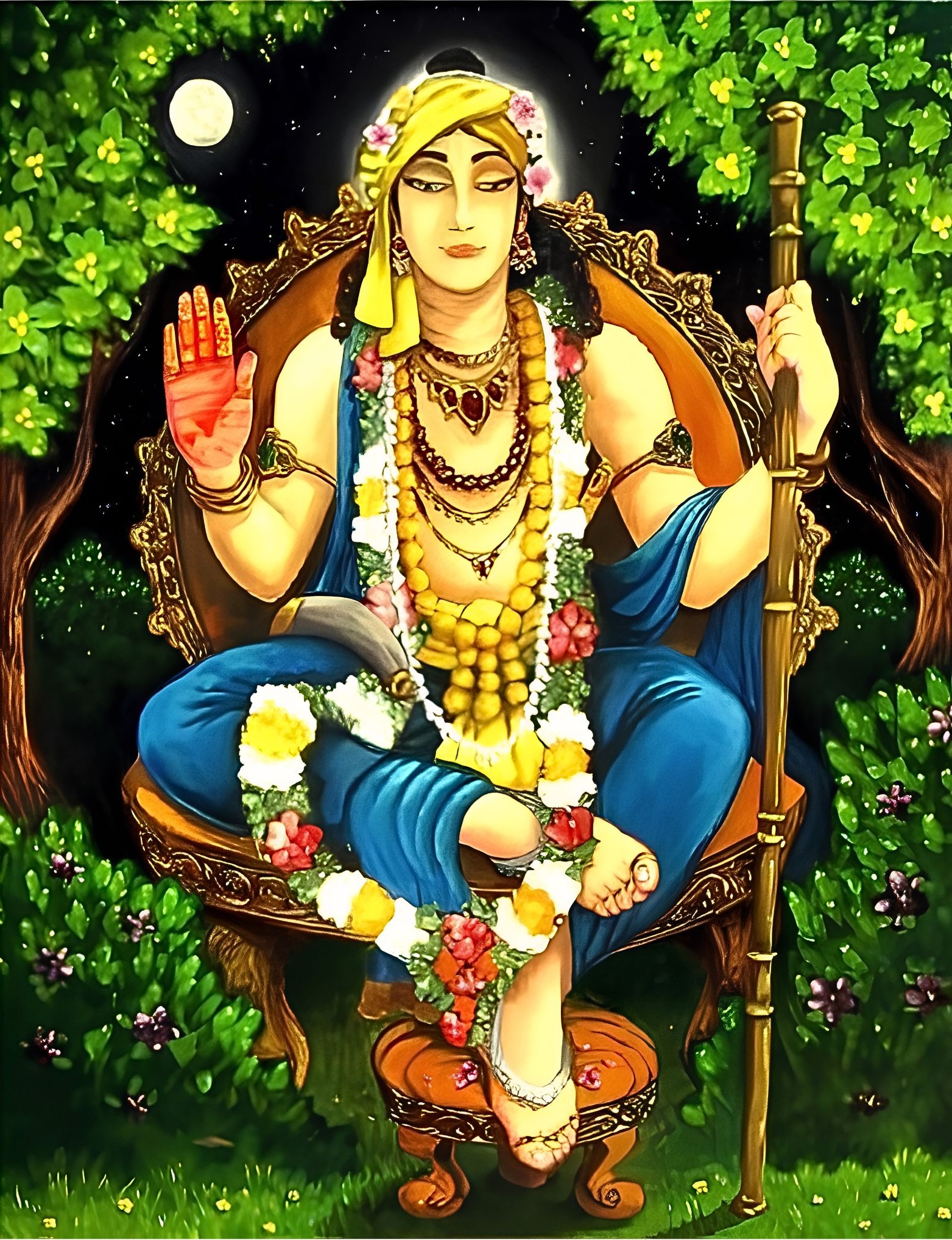
There is a lila found in Śrī Caitanya Bhāgavata involving Nityānanda Prabhu and the redeemed scoundrel Mādhāi, taking place sometime after the more famous incident with Mādhāi and his brother Jagāi.
After receiving the causeless mercy of Śrīmān Mahāprabhu, Jagāi and Mādhāi became pure devotees. They lived in a simple hut on the banks of the Gaṅgā, chanting mahāmantra and atoning for their past misdeeds.
However, Mādhāi was haunted by his mistake. Both brothers were fallen and committed every sin on the books, but Mādhāi was the one who struck Lord Nityānanda’s body and drew His blood with his own hands. Now that Śrī Nitāi’s divine status was revealed, Mādhāi could not forgive himself.
One day, he happened to meet Śrī Nitāi. Weeping, he fell at His lotus feet, lamenting his sin and begging for forgiveness.
Smiling, Nityānanda Prabhu replied, “Is a father upset when his small son strikes him? This is exactly how I felt with you. All of this was already forgiven before you asked.”
Lifting him up and embracing him, Śrī Nitāi sent Mādhāi on his way with the simple instructions to chant mahāmantra, refrain from his old misbehavior, and serve the community by building a bath ghat.
As our Lord Nitāi is akhaṇḍa-guru-tattva, Śrī Guru has the same attitude of unconditional love and forgiveness, especially towards his disciples, whom he considers as his own children. No matter what mistakes they make, he is always sending them love and blessings, a constant flow of grace. Even his chastising is a great blessing.
As disciples, it is our constant work to learn to see Śrī Gurudeva’s blessings in all events of our lives, to recognize his incredible mercy, and to try to make our own hearts just one small fraction as soft and loving as his.
Our Prabhupādas beautifully demonstrate the causeless mercy of Guru tattva in all their relations with their disciples. They give shelter of their lotus feet to anyone who asks, without looking for qualifications.
In the lives of our modern ācāryas and previous generations, we can find many examples of Lord Nityānanda’s descendants extending forgiveness and a chance for redemption even to criminals and murderers. In some cases, they have even given dīkṣā to such fallen souls—out of pure compassion, since otherwise those people would face countless lifetimes of suffering as result of their sins. This is no small act on their part, considering that at the time of initiation, the guru takes on the bad karma of his disciples.
Once that connection is made, Śrī Gurudeva continues to take on the bad and give only the good to his disciples. This happens automatically at all times, without us having to ask.
So every disciple must be very careful to avoid aparādha, knowing that it is their Gurudeva who will bear the weight of their offenses!
Learning to Find Blessings Everywhere
Our Gurudeva, Prabhupāda Śrīla Premgopāl Gosvāmī, often says that Bhagavan and human beings are both forgetful but in different ways: Bhagavan is always forgetting our offenses while we are always forgetting His mercy.
The Lord’s mercy, which comes to us in the form of Gurudeva’s mercy, is showering on us at all times, although we are not aware of it.
Gurudeva is always with us, seated as caitya-guru in the heart, guiding and protecting us. Even if we are struggling, even if we are falling short again and again, he is with us. Even before we knew him in this lifetime, before the first thought about bhakti entered our mind, then already he was with us, carefully arranging everything so eventually we would be ready to come to him in person. Everything in our lives, no matter how difficult, was exactly perfect for giving us the lessons we needed.
But we are Kali-yuga jīvas: our expertise is finding faults. By nature, we are constantly overlooking the good and focusing on the bad. So we look at our own lives and see struggle, suffering, failure, unfairness; we don’t immediately see the blessings.
We have to train ourselves for this. We have to learn to control our minds, to change our focus and the way we react to life’s events. We have to practice seeing the good in any situation and in every person.
There is always some silver lining. On this subject, our Gurudeva sometimes tells the story of when he and his father were bringing Śrī Śrī Rādhā Madana-Mohana from Navadvīpa to Vṛndāvana. There were around 250 devotees with them, and because of the large group they were not able to board one local train and missed their connection.
The disciples were all upset, but Prabhupāda Śrīla Madangopāl Gosvāmī remained unfazed, saying, “This is for the best.”
As it turned out, some hours later the train they were meant to take had a severe accident and many people were killed. Only then it became clear how Śrī Rādhā Madana-Mohana had protected them in a way that seemed at first like misfortune.
“Ok,” you might object, “that was a lucky turn, but what about this thing that happened to me? Nothing good came of it. I just got broken and beaten down, I can’t find a single benefit.”
But can you see everything? Can you really say now how the rest of your life will play out and what may come years down the line as a result of that experience? What seems like the worst disaster may turn out to be the greatest blessing, in ways you never could foresee when you were in the middle of it.
Even Śrī Gurudeva’s instructions may be obscure at the time. Your Gurudeva might tell you something confusing or even contradictory, but if you keep those words in your heart, months or years later their deeper truth will be revealed.
At the very least, when all else fails you can say, “That was my karma coming to me, I must have done something really nasty in a past life, and by Gurudeva’s mercy it caught up to me like this and not something even worse.” You can’t know with your material mind, but like this you train yourself to look for blessings and to trust in hidden providence. And the more you trust, the more space is open for Gurudeva to work real miracles in your life.
There is no limit to Gurudeva’s mercy, only to our capacity to receive it.
Forgiving and Asking For Forgiveness
Forgiveness is an essential quality of a Vaiṣṇava. Our Gurudeva always encourages us to forgive and ask forgiveness—in fact, he tells us to make a daily practice of it. When we first wake up in the morning and right before sleeping, we should ask forgiveness from everyone we have offended, and forgive all who have offended us.
Vaiṣṇava aparādha is a great danger to our bhajan and it can only be cleared by begging for forgiveness from that Vaiṣṇava. Even if we didn’t mean any harm, still that aparādha will sit on us until we make it right with them.
However, asking in person is not always possible. We make so many mistakes out of ignorance; we may never know what we have done or to whom. Therefore, twice per day we pray for forgiveness and offer forgiveness to others, so that our hurt feelings will not interfere in their bhajan.
If we want to call ourselves a Vaiṣṇava, we must first be able to see all others as Vaiṣṇava, not only those wearing tilaka and kaṇṭhī mālā. Every living being has Lord Viṣṇu seated in their heart; every being is part of Śrī Kṛṣṇa and is eternally His servant. How much of this we perceive depends more on us than on them. It is already there for those who have eyes to see.
You might feel someone is irredeemable. Yes, maybe this person genuinely, needlessly hurt you and has not even tried to make it right. This happens sometimes. You don’t have to pretend like it didn’t hurt.
But still, underneath it all, this person also has Lord Viṣṇu seated in their heart.
Everyone in our lives is here for a reason. One way or another, we are all helping each other learn how to love. And we do not really know who anyone else is. That very person who hurt you may be a siddha mahātmā in disguise, here to give you some special teaching or move you safely through a difficult karma. You don’t know, you can’t prove it. But if you think like this, the whole situation softens. The knot around the wound starts to unravel.
So on the outside, maybe you need to draw a hard line, but in your heart, thank you, daṇḍavat praṇāma. Humbler than a blade of grass, as tolerant as a tree: thank you, thank you, thank you.
The Gift of Siddha Deha
And then there is Gurudeva’s supreme act of mercy: revealing to us our mañjarī form.
This can only come through mercy. The shastras are very clear on this: we cannot earn our siddha deha through sadhana or any degree of effort on our part. Only Śrī Gurudeva can give it to us, at the time he knows is right. It is a gift, and one so generous we don’t even know how to appreciate it with our mundane minds—the crown jewel of Śrīmān Mahāprabhu’s offering to us Kali-yuga jīvas, so that we can serve Śrīmati Radharani directly in Her most intimate pastimes. In no other way is this possible.
None of us are worthy of this, but Śrī Gurudeva gives it to us anyway. He will take us to nikuñja kuṭīr personally, guiding us with his own hand, although we are all totally unqualified. For every one of his disciples, he will come back lifetime after lifetime until we are all there, serving together as junior mañjarīs under our loving guru-mañjarī.
We fall down again and again; again and again, he picks us up. We may lose faith, fall from the path, or try to give up. He will not give up on us. It is his duty as Śrī Guru and the expression of his love for all his disciples.
If we only understood how merciful is Śrī Gurudeva, our Śrī Nitāi, and our Śrīmati Radharani, how much love They want to shower on us at every moment, we would never be afraid again.
This article is a small offering of gratitude to Śrī Gurudeva. For those reading, we hope it will bring some inspiration and greater attachment to Gurudeva and paramparā. All mistakes our ours; please forgive us for them.
Jai Nitāi! Jai Śrī Gurudeva!