

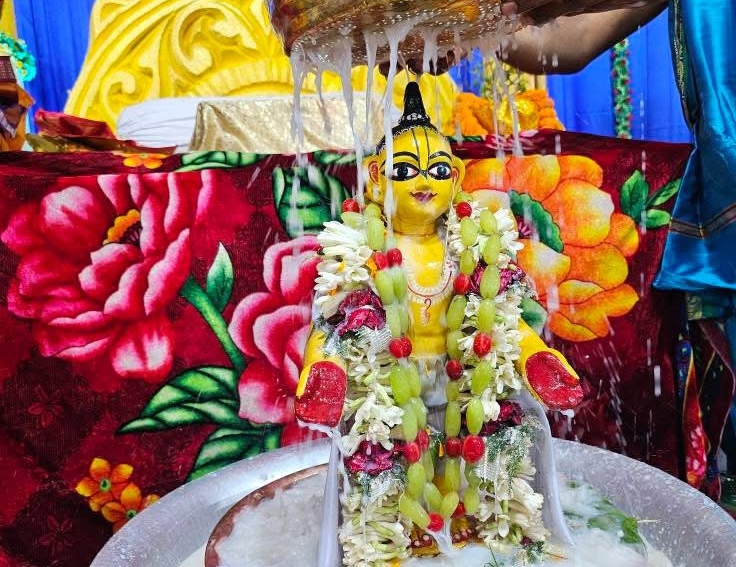
The darkness of Kali-yuga is all around us. Selfishness, ignorance, and materialism are the rule of the day, and there seems to be no end in sight. Ancient wisdom and values are rapidly disappearing. Today’s world appears very harsh and with little space left for softness, beauty, or genuine connection. Even the dhāma is receding from view, as the green fields of Vraja disappear under concrete.
Born into this age of struggle, our lives are short and besieged by obstacles. We may try to use what little time we have for spiritual practice, but even then our minds are cloudy, unfocused, and easily drawn into the thousand material distractions that await us on all sides.
And yet, our ācāryas tell us how fortunate we are to be born here and now.
More fortunate than those in any other age, because here in this specific Kali-yuga, we can take shelter of Śrī Kṛṣṇa Caitanya Mahāprabhu.
Śrīmān Mahāprabhu’s appearance is exceedingly rare, hidden from the Vedas and inconceivable even to the highest of the demigods. He does not come in every Kali-yuga, but only once every 2000 Catur-yugas—once in every day of Brahmā, or 8 billion 640 million human years. Just think how remarkable it is that those of us alive today are walking the planet only 500 years since He pressed His lotus feet to the same ground.
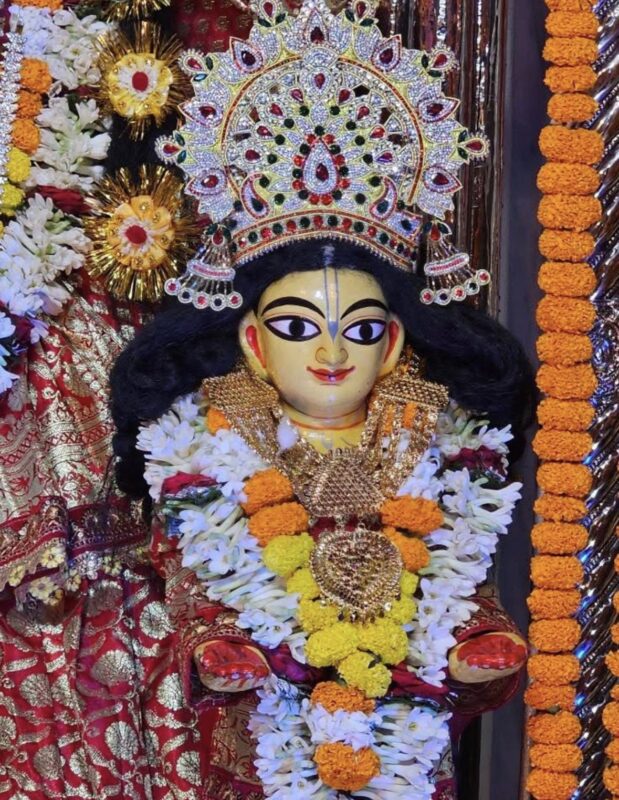
Mahāprabhu is not an avatāra, but rather the source and essence of all avatāras: avatāra-sāra Gaura-avatāra. He is Kṛṣṇa Himself, appearing again with the mood and complexion of Śrīmatī Rādhārāṇī. The external reasons for His manifestation are well known; we will discuss a unique aspect of His internal reasons for taking this marvelous form.
rādhā kṛṣṇa-praṇaya-vikṛtir hlādinī śaktir asmād
ekātmānāv api bhuvi purā deha-bhedaṁ gatau tau
caitanyākhyaṁ prakaṭam adhunā tad-dvayaṁ caikyam āptaṁ
rādhā-bhāva-dyuti-suvalitaṁ naumi kṛṣṇa-svarūpam
The loving affairs of Śrī Rādhā and Kṛṣṇa are transcendental manifestations of the Lord’s internal pleasure-giving potency. Although Rādhā and Kṛṣṇa are one in Their identity, previously They separated Themselves. Now these two transcendental identities have again united, in the form of Śrī Kṛṣṇa Caitanya. I bow down to Him, who has manifested Himself with the sentiment and complexion of Śrīmatī Rādhārāṇī although He is Kṛṣṇa Himself. (Śrī Caitanya-caritāmṛta, Ādi 1.5)
Why did Kṛṣṇa, the Supreme Personality of Godhead, appear again as a devotee? If He wanted to teach us devotion practically, He could have sent any associate or empowered any of His devotees. It is because He wanted to practice and experience the love of His devotees. The devotees’ love is more pure than Kṛṣṇa’s, because they are always practicing. He is accustomed to being the object of worship (viṣaya), while the devotees are always the worshipers (āśraya).
Kṛṣṇa is very expert at relishing all different types of love—dāsya, sakhya, vātsalya, mādhurya—as well as all the secondary rasas, which He enjoys in conjunction with the primary rasas or with specific devotees in special līlās.
So many different flavors of love with so many different devotees! Even among associates in the same bhāva, it is not all the same. The parental love Kṛṣṇa receives from Mother Yaśodā is not the same as that from Nanda Bābā. The friendly love He shares with Śrīdāma is not the same as He shares with Madhumaṅgala. Śrīmatī Rādhārāṇī understands this very well—after all, They share the same heart—and so She arranges for Him to have His pastimes with many different girls, while knowing full well that He will only ever be satisfied with Her, as She is the deep well of all rasa.
But in all of these arrangements, Kṛṣṇa still remains primarily the receiver. He has never been in the position of His devotees, never been engaged in worship, and finally He becomes aware that because of this He is missing out on something very sweet. As a result, He develops three desires, which are the main confidential reasons for His appearance.
śrī-rādhāyāḥ praṇaya-mahimā kīdṛśo vānayaivā-
svādyo yenādbhuta-madhurimā kīdṛśo vā madīyaḥ
saukhyaṁ cāsyā mad-anubhavataḥ kīdṛśaṁ veti lobhāt
tad-bhāvāḍhyaḥ samajani śacī-garbha-sindhau harīnduḥ
Desiring to understand the glory of Rādhārāṇī’s love, the wonderful qualities in Him that She alone relishes through Her love, and the happiness She feels when She realizes the sweetness of His love, the Supreme Lord Hari, richly endowed with Her emotions, appeared from the womb of Śrīmatī Śacī-devī, as the moon appeared from the ocean. (Śrī Caitanya-caritāmṛta, Ādi 1.6)
1. To understand the glory of Śrīmatī Rādhārāṇī’s love
2. To experience His own beauty and sweetness that She alone relishes through Her love
3. To experience Śrīmatī Rādhārāṇī’s happiness in Their meeting
But among all the devotees, why did he choose only Śrī Rādhā’s mood?
Of all Kṛṣṇa’s lovers in their different moods, Rādhārāṇī is the highest. Her love is the most pure, the most intense, and the most overwhelmingly sweet. She is the one from whom He must learn. In Dvāpara-yuga, Kṛṣṇa could see that Śrīmatī Rādhārāṇī was enjoying something far beyond His own pleasure in Their līlās, but He would not experience or understand it until He Himself entered into Her mood.
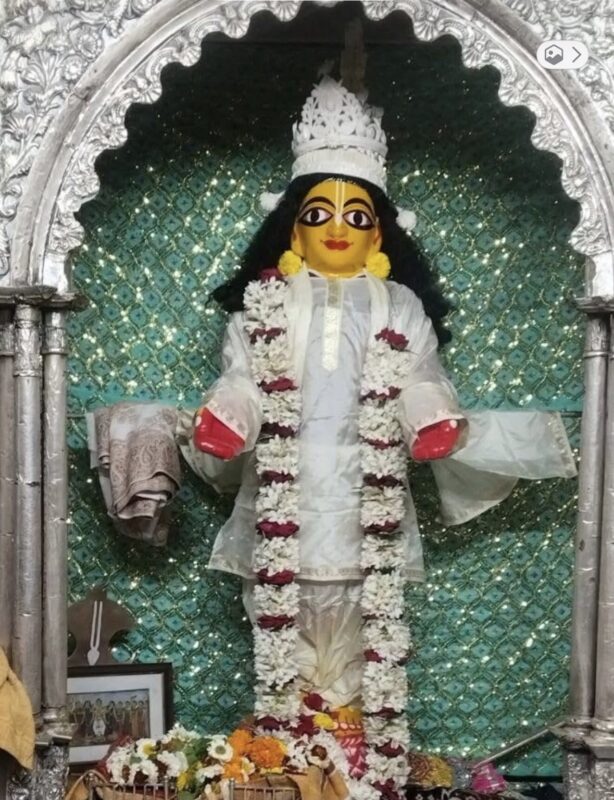
Compared to Śrīmatī Rādhārāṇī, Kṛṣṇa is only a beginner in prema. Think of a mango: when unripe it is green and hard, but when ripe it becomes soft, sweet, and golden.
In His previous līlā, Kṛṣṇa was somewhat hard in heart. He always kept a smile on His face; He never cried for Rādhārāṇī and the gopīs the way they cried for Him. He had love in His heart, but mostly He did not let it show. He preferred to play games. Only in certain special līlās, such as in Vilāpa-kusumāñjali, when He was defeated by Śrīmatī Rādhārāṇī and left unconscious in the cave of Govardhana, did He reveal the true depth of His love for Her.
Sometimes Kṛṣṇa tried to serve Rādhārāṇī in the same way as the mañjarīs, but He did not manage it very well. When He is in the mood of Rādhā-dāsya, one touch of Her lotus feet causes Him to lose consciousness. That mood is too high for Him. So Rādhārāṇī will swing Her feet onto His lap and order Him to apply red lac, but He is unable to do so. He trembles, tears of ecstasy flowing from His eyes, and the mañjarīs must gently push Him aside to perform the sevā themselves.
This was His mood in Dvāpara-yuga. In Kali-yuga, as Śrī Gaurāṅga Mahāprabhu, He never stops crying. He is the same Kṛṣṇa, but His mood and His color have changed. Now He is learning to love as She does.
Kṛṣṇa would fall unconscious from a single touch of Rādhikā’s feet. He could never bear the full force of Her love alone. She knew this, so when His desire arose to know Her mood from within—when He asked for even one drop of it—She did not allow Him to take it alone. She knew that in Her deep states of viraha, She would lose outer awareness. She would fall to the ground and roll in the dust, or run through thorns and over sharp stones. Sometimes She would stand upon the sūrya-kāntamaṇi, a gem that at noontime burned a thousand times hotter than the sun, and not even notice it scorching Her butter-soft feet.
She could not allow this for Her beloved. Thus She agreed only on the condition that She would accompany Him to protect Him. In this new form, She envelops Kṛṣṇa, covering Him with Her golden effulgence. Externally, Śrī Gaurasundara is Śrīmatī Rādhārāṇī; internally, He is Śyāmasundara.
Ordinarily, our worship of Kṛṣṇa is not complete without Śrīmatī Rādhārāṇī—we cannot worship Him alone. But in Gaura-līlā, both are present within this single form. As long as we remain absorbed in the supremely beautiful form of Gaurāṅga Mahāprabhu, keeping His lotus feet within our hearts, our bhajana is complete.
yathā yathā gaura-padāravinde
vindeta bhaktiṁ kṛta-puṇya-rāśiḥ
tathā tathot-sarpati hṛdy akasmād
rādhā-padāmbhoja-sudhāmbū-rāśiḥ
As a greatly pious person engages in devotional service to the lotus feet of Sri Gaurasundara, the ocean of nectar that is the service of the lotus feet of Sri Radha is simultaneously born in his heart. (Caitanya-candrāmṛta 88)
However much attachment we have for Mahāprabhu, that much also we will naturally and automatically develop for Śrīmatī Rādhārāṇī.
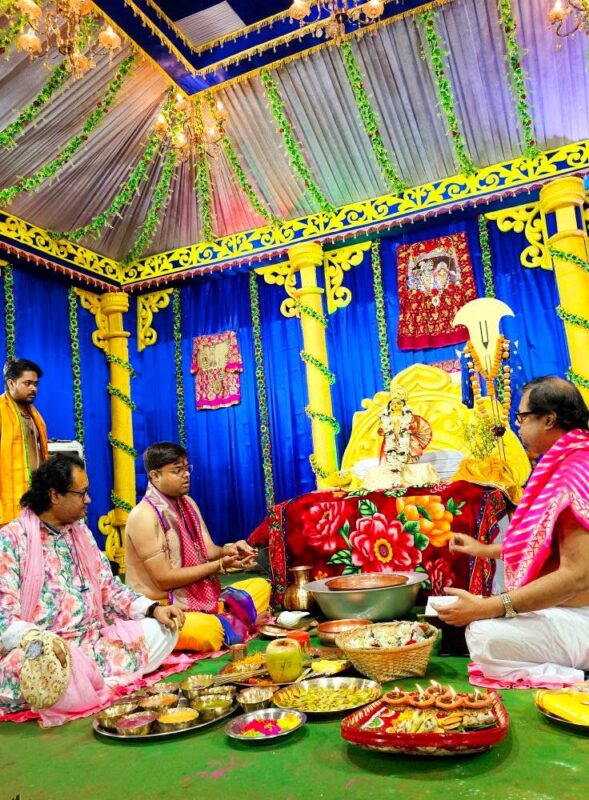
If a coconut falls into the Pacific Ocean, the current will carry it into the Indian Ocean. In the same way, if you immerse yourself in the ocean of Gaura-prema, you will find yourself in the ocean of Rādhā-prema.
The best way to please Sriman Mahaprabhu is by following His footsteps and living according to His teachings.
He taught three essential principles:
Jiva daya – to be loving, compassionate and respectful toward all living beings.
Nama ruci – to continuously chant the Holy Name with love and humility.
Vaishnava seva -to serve the Vaishnavas with sincerity and devotion.
Let us dive deep into the ocean of Gaura-prema.
This article was a small attempt for the pleasure of the Vaiṣṇavas. Just as when milk is mixed into water, a swan will drink the milk and leave the water behind, so please accept the good points from here and forgive any mistakes.